|
 |
 |
 |
 |
 |
 |
 |
 |

 |
Double Star Instrument Commissioning Started
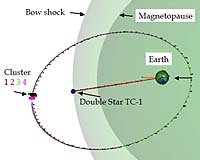
Paris - Jan 27, 2004 The first Double Star spacecraft was successfully launched from Xichang, Southern China, on 29 December 2003 at 19:06 UT. The final operational orbit is 570 by 78 970 km, with an inclination of 28.5 degrees. Due to an over-performance of the upper stage the apogee is about 12 000 km more than expected. This should not affect the scientific objectives. Furthermore, the spacecraft will now observe the Earth bow shock, which was not in the original scientific objectives. A preliminary estimate reveals that that the number of conjunctions with Cluster has decreased slightly, but this is compensated by the longer time interval for each individual conjunction. Spacecraft Status: One solid boom, carrying the fluxgate magnetometers (FGM), has been deployed successfully. The other one, carrying the search coil (STAFF/DWP), is still un-deployed after an initial attempt to deploy it. Chinese spacecraft engineers are investigating the source of the problem and will make another attempt in the next few weeks. This, however, does not affect the stability of the spacecraft and the spin axis is as expected close to the North ecliptic pole.
Instrument Commissioning started in early January:
STAFF/DWP Both instruments have detected an electromagnetic noise, which is likely related to the boom asymmetry causing solar array shadowing; an investigation is on going to identify the source and try to eliminate it.
PEACE (electron detector)
ASPOC (ion emitter)
HIA (ion detector) In other news ESA can report that all three European experiments are being delivered to Beijing for the second Double Star spacecraft, which will start its integration early February for a launch in July 2004. Community Email This Article Comment On This Article Related Links Double Star SpaceDaily Search SpaceDaily Subscribe To SpaceDaily Express Solar Science News at SpaceDaily
 Twin APL-Built Solar Probes Shipped To NASA Goddard For Pre-Launch Tests
 Greenbelt MD (SPX) Nov 10, 2005
The first spacecraft designed to capture 3-D "stereo" views of the sun and solar wind were shipped Wednesday from the Johns Hopkins University Applied Physics Laboratory to NASA Goddard Space Flight Center for their next round of pre-launch tests. |
|
|

| The content herein, unless otherwise known to be public domain, are Copyright 1995-2006 - SpaceDaily.AFP and UPI Wire Stories are copyright Agence France-Presse and United Press International. ESA PortalReports are copyright European Space Agency. All NASA sourced material is public domain. Additionalcopyrights may apply in whole or part to other bona fide parties. Advertising does not imply endorsement,agreement or approval of any opinions, statements or information provided by SpaceDaily on any Web page published or hosted by SpaceDaily. Privacy Statement |