|
 |
 |
 |
 |
 |
 |
 |
 |

 |
Double Quantum Dots Control Kondo Effect
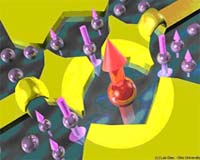
Athens OH (SPX) Sep 20, 2006 Two quantum dots connected by wires could help scientists better control the Kondo effect in experiments, according to a study by Ohio University and University of Florida physicists published in a recent issue of Physical Review Letters. The Kondo effect occurs when electrons become trapped around the magnetic impurities in semiconductor materials, which prompts the electrons to change their spin. This phenomenon has intrigued scientists, as electronic correlations can create interesting and complex behavior in materials. In the new work, scientists demonstrate how the two quantum dot system can behave in two different and interesting ways: As a simile for a Kondo-effect system where one quantum dot is used to "filter" the effect of the current leads, and as a way to study "pseudo-gapped" systems and correlations in them, which can help scientists understand structures such as superconductors. "This last part is of great current interest to theorists and experimentalists who are exploring what are called quantum phase transitions, which are changes in systems that alter their behavior dramatically as a function of some parameter while remaining at zero (or very low) temperature," said Sergio Ulloa, a professor of physics and astronomy at Ohio University. The study, funded by the National Science Foundation, was conducted by Luis Dias da Silva, Nancy Sandler and Ulloa, all members of the Ohio University's Nanoscale and Quantum Phenomena Institute, and Kevin Ingersent of the University of Florida. Community Email This Article Comment On This Article Related Links Powering The World in the 21st Century Nano Technology News From SpaceMart.com Computer Chip Architecture, Technology and Manufacture
 Electric Jolt Triggers Release Of Biomolecules, Nanoparticles
 Baltimore MD (SPX) Sep 20, 2006
Johns Hopkins researchers have devised a way to use a brief burst of electricity to release biomolecules and nanoparticles from a tiny gold launch pad. The technique could someday be used to dispense small amounts of medicine on command from a chip implanted in the body. The method also may be useful in chemical reactions that require the controlled release of extremely small quantities of a material. |
|
|

| The content herein, unless otherwise known to be public domain, are Copyright 1995-2006 - SpaceDaily.AFP and UPI Wire Stories are copyright Agence France-Presse and United Press International. ESA PortalReports are copyright European Space Agency. All NASA sourced material is public domain. Additionalcopyrights may apply in whole or part to other bona fide parties. Advertising does not imply endorsement,agreement or approval of any opinions, statements or information provided by SpaceDaily on any Web page published or hosted by SpaceDaily. Privacy Statement |