|
 |
 |
 |
 |
 |
 |
 |
 |

 |
Don't Hobble NATO, US Tells Allies
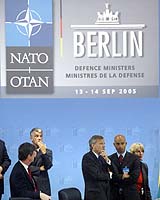
Berlin (AFP) Sep 13, 2005 US Defense Secretary Donald Rumsfeld urged allies Tuesday not to hobble NATO commanders in places like Afghanistan and Kosovo by putting national restrictions on the use of their forces. Rumsfeld joined NATO defense ministers here for an informal two day meeting on progress in forming a NATO rapid reaction force as well as plans for expanding the NATO-led force in Afghanistan over the next year into more volatile southern parts of the country. "One of the issues we'll have to wrestle with is the reality that while a number of NATO nation been reducing the restrictions that they impose on their forces ... some nations have not yet done that," he said. Although he identified no country by name, Rumsfeld alluded to an incident last year in Kosovo in which German NATO troops failed to respond to a serious outbreak of ethnic unrest because of their national rules of engagement. He complained that so-called national caveats -- restrictions that governments place on the use of their forces in NATO missions -- are so numerous it takes 17 pages to list them all. "They vary all across the spectrum," he told reporters on the flight here from London, where he made a brief stop on his way to the NATO meeting. A senior US defense official cited restrictions on the use of riot control agents and on the movement of forces from assigned geographical locations as among the most troublesome caveats. With NATO expanding its peacekeeping operations in Afghanistan next year, the issue of what restrictions might be placed on their use has taken on greater prominence. NATO forces are slated to move into the volatile southern regions of Afghanistan by mid 2006, where the risk of attack from Taliban insurgents is high. Rumsfeld said the NATO-led International Security Assistance Forceeventually would be ready to move into the eastern border regions, where US forces have been battling insurgents. He said coalition troops would continue to be responsible for counter-insurgency operations for the time being. "It would be nice if NATO developed counter-terrorism capabilities which don't exist at the present time as a NATO function," he said. "That would most likely be the last piece that they would take." The future relationship between the US force and ISAF is still being worked out, a senior defense official traveling with Rumsfeld told reporters. French Defense Minister Michele Alliot-Marie rejected putting both forces under a single NATO command, which a NATO spokesman said was one of the options under discussion. "We can improve the synergy but these two missions (ISAF and OEF) must remain separate," she said. The defense ministers debated other related issues at the meeting, including funding for operations of a new NATO Response Force (NRF) designed for crisis intervention outside Europe. Rumsfeld said some way had to be found to increase common funding for NRF operations. NATO's current system requires that countries foot the bill for troops they contribute to alliance missions. "So there is a perverse disincentive whereby countries who might be politically willing to step up to the plate, and shoulder the responsibility, may have a problem in paying for it," a senior US defense official told reporters. "The countries who are willing to provide manpower and other capabilities should not be penalized," he said. France and Germany, however, indicated they opposed common funding for NATO operations, while suggesting NATO should help out countries that contribute forces but can't afford to pay their own way. "We do not want common funding to be generalized," said France's Alliot-Marie. Community Email This Article Comment On This Article Related Links SpaceDaily Search SpaceDaily Subscribe To SpaceDaily Express
 The EUs Grim Year
 Washington (UPI) Jan 05, 2006
After a grim year of slow growth, riots and terror attacks from its Muslim immigrant underclass, rows over its budget and two thumping rejections by Dutch and French voters of its planned new constitution, the European Union's leaders can hardly wait for 2005 to be over to make a fresh start in the New Year. |
|
|

| The content herein, unless otherwise known to be public domain, are Copyright 1995-2006 - SpaceDaily.AFP and UPI Wire Stories are copyright Agence France-Presse and United Press International. ESA PortalReports are copyright European Space Agency. All NASA sourced material is public domain. Additionalcopyrights may apply in whole or part to other bona fide parties. Advertising does not imply endorsement,agreement or approval of any opinions, statements or information provided by SpaceDaily on any Web page published or hosted by SpaceDaily. Privacy Statement |