
 |
 |
 |
 |
 |
 |
 |
 |
 |

 |
Don't Blink In Deep Space
JPL - July 25, 1999 -  JPL - July 25, 1999 - DS1 got some help from the operations team this past week. Previous recordings have described the impressive performance of AutoNav in determining its location and course.
But because of shortcomings in the camera, it is not quite accurate enough for the job of guiding DS1 to its extraordinarily close encounter with Braille. So engineers borrowed the navigation pictures AutoNav took and performed more analyses with them than AutoNav is designed to do, so they were able to improve upon AutoNav's results. The work performed by humans in this case could have been done easily by AutoNav if the necessary instructions had been on board. For the first time in nearly 5 months, an update to its location was transmitted to DS1. AutoNav now combines that information with its own navigation estimates as it progresses toward the asteroid. To keep DS1 on course, AutoNav designed a course correction and executed it on Friday. But it turned out that in order to point the ion engine in the desired direction, the orientation of the spacecraft would have allowed the Sun to point at the camera and the device that tracks stars, imaginatively known as the star tracker. So the on-board system did what the operations team refers to as "vectorizing the burn": it computed two different orientations that were acceptable for ion engine firings that combined to produce the desired effect. Then AutoNav turned the spacecraft, used the ion propulsion system for 3 hours, and then turned DS1 again and fired it again for another 3 hours before turning back to point the main antenna at Earth. The course correction went well and changed the spacecraft speed by about 2.5 miles/hour. Very little is known about asteroid Braille. Even estimates of its size are quite uncertain, but it is probably just a few kilometers in diameter (perhaps a mile or so). This is the smallest solar system body ever targeted for a spacecraft encounter. In fact, the asteroid is so small that it has been difficult for astronomers to determine its exact location, and it is still too far away for the spacecraft to see it. Beginning today however, whenever AutoNav takes pictures of larger, more distant asteroids for its navigational fixes, it also will try to find asteroid Braille. As expected, the tiny asteroid did not show up in this morning's pictures, even though it is only a little over 3 days before the spacecraft arrives. One of the greatest uncertainties right now is where the asteroid really is, and the sooner AutoNav can spot its target, the better job it can do zeroing in on it. Braille apparently rotates very slowly, taking nearly 10 Earth days to complete one turn. Although DS1 was designed to test technologies, it will attempt to make scientific measurements when it flies past the asteroid. Black and white pictures may reveal Braille's size and shape and show craters, hills, valleys, and other topography. Infrared measurements may help scientists determine the minerals that make up the surface. By searching for changes in the solar wind, the stream of charged particles flowing from the Sun, in the vicinity of the asteroid, it may be possible to determine if it has a magnetic field. Perhaps the solar wind or sunlight even cause surface material to be slowly eroded from the asteroid and flung into space, in which case the spacecraft may directly measure the resulting free atoms. To get close enough to make all these measurements, AutoNav will attempt to bring DS1 closer to Braille than any spacecraft has ever come to a solar system body without actually landing on it. Speeding by at 15.5 km/s, or nearly 35,000 miles/hour, the spacecraft will pass by more than 50 times faster than a commercial jet and more than twice as fast as the space shuttle. But it will come a mere 15 kilometers from the center of the asteroid, or less than 9 miles from the surface. This is a great challenge to AutoNav and to the operations team, but if it works this high risk encounter should be exciting indeed. The small operations team has been continuing to refine the complex set of instructions that will govern the spacecraft, including the ones that give AutoNav the opportunity to design and execute more maneuvers to keep the spacecraft on course, the commands to the new technology science instruments to collect data, directions to the attitude control system on how to turn the spacecraft as it nears the asteroid, and instructions on how to transfer, manipulate, and store the large volume of data to be collected. Completing this unusually complex choreography, in which all the spacecraft systems including AutoNav need to work together, is the focus of the team's work right now. A group of instructions is known as a sequence, and each day, the sequences covering the final 6 hours before the closest approach to Braille are run through the Deep Space 1 test facility at JPL. This is a simulation of the spacecraft, created using some hardware similar to what is on the real spacecraft and some computer programs that emulate the behavior of other parts of the spacecraft. The test facility is certainly not identical to the spacecraft, so a successful test does not guarantee success on the spacecraft, but it has allowed many of the bugs to be worked out. The final sequences will be radioed to DS1 on Monday. In the meantime, AutoNav will continue to check its course and, if necessary, make course corrections as it closes in on the asteroid. DS1's closest approach to the asteroid will occur at approximately 9:46 pm PDT on Wednesday, and it will be several hours after that before it can begin reporting its results to Earth. Returning all the data may require several days; this recording will be updated on Thursday or Friday with a report on the outcome of this exciting adventure. Deep Space 1 is still about 4.3 million kilometers, or 2.7 million miles, from Braille. The spacecraft is now almost 25% farther away from Earth than the Sun is and over 480 times as far as the moon. At this distance of over 185 million kilometers, or more than 115 million miles, radio signals, traveling at the universal limit of the speed of light, take almost 21 minutes to make the round trip.
Deep Space 1 Reports From Spacer.Com
Email This Article Comment On This Article Related Links Space
 Satellite Launch To Boost DTH In India
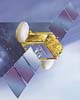 Calcutta, India (SPX) Dec 28, 2005
The successful launch Thursday of India's heaviest satellite from spaceport of Kourou in French Guyana may have boosted the country's space research efforts to yet another level, but it has also lifted the spirits of at least three Direct-To-Home televisions broadcasters, one of which has been waiting for years to launch its services in India. |
|
|

|
|
|
|
|
|
|
|
|
|
|
|
| The content herein, unless otherwise known to be public domain, are Copyright 1995-2006 - SpaceDaily.AFP and UPI Wire Stories are copyright Agence France-Presse and United Press International. ESA PortalReports are copyright European Space Agency. All NASA sourced material is public domain. Additionalcopyrights may apply in whole or part to other bona fide parties. Advertising does not imply endorsement,agreement or approval of any opinions, statements or information provided by SpaceDaily on any Web page published or hosted by SpaceDaily. Privacy Statement |

