|
 |
 |
 |
 |
 |
 |
 |
 |

 |
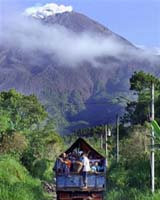
Dome Shape Of Indonesias Merapi Changing Quickly
Mount Merapi, Indonesia (AFP) May 09, 2006 A new dome at the peak of Indonesia's simmering Mount Merapi was changing quickly Monday and more ominous lava oozed down its slopes but residents were not ordered to evacuate, a scientist said. "Although the morphology of the new dome is changing at a relatively fast pace, my superior has not yet seen the need to raise Merapi's alert status to its highest level," said Triyani from the volcanology office in Yogyakarta, 30 kilometers (18.5 miles) south of the volcano. Merapi, which towers over a fertile Central Java plain and provides livelihoods for thousands of people living around its slopes, was put on "standby" alert status more than three weeks ago. If boosted to its highest level, residents face mandatory evacuation. Triyani said that 67 more lava flows were recorded flowing from the new dome at the peak of the 2,914-meter (9,560-foot) volcano since Sunday night. "We are still in the process of studying all scientific data that we have obtained before we can decide whether or not the alert status should be upgraded," Triyani told AFP. More than 5,000 people have fled their homes around the volcano so far but many return to work near their homes during daylight hours. The new dome has been forming on Merapi for more than a week, signalling that the eruption would involve an outflow of lava and deadly heat clouds rather than a massive explosion, scientists have said. In its last large eruption in 1994, heat clouds known locally as "shaggy goats" careened down the volcano at more than 100 kilometres (60 miles) per hour, reaching temperatures of 600 degrees Celsius (1,100 degrees Fahrenheit). The clouds killed 66 people. Merapi's most deadly eruption occurred in 1930, when 1,369 people were killed. It also erupted in 1994, killing 66 people. Indonesia sits on the Pacific "Ring of Fire" noted for its volcanic and seismic activity. The country has more than 100 active volcanoes.
Source: Agence France-Presse Community Email This Article Comment On This Article Related Links - Bringing Order To A World Of Disasters When the Earth Quakes A world of storm and tempest
 102 Dead After Four Months Of Heavy Rains In Colombia
 Bogota (AFP) May 09, 2006
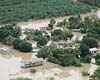
Heavy rains and flooding since the beginning of the year have killed 102 people and damaged thousand of homes across much of Colombia, according to state rescue agency Socorro Nacional. On Sunday, four more people died in a landslide in a poor Bogota neighborhood, and much of the capital remains under emergency warning due to elevated river levels. |
|
|

| The content herein, unless otherwise known to be public domain, are Copyright 1995-2006 - SpaceDaily.AFP and UPI Wire Stories are copyright Agence France-Presse and United Press International. ESA PortalReports are copyright European Space Agency. All NASA sourced material is public domain. Additionalcopyrights may apply in whole or part to other bona fide parties. Advertising does not imply endorsement,agreement or approval of any opinions, statements or information provided by SpaceDaily on any Web page published or hosted by SpaceDaily. Privacy Statement |