|
 |
 |
 |
 |
 |
 |
 |
 |

 |
Does The Atmosphere Of Pluto Go Through The Fast-Freeze
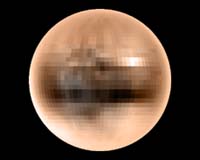
Boulder CO (SPX) Sep 25, 2006 A study of Pluto's bright frosts suggests that the way the planet cools down is rapid and disorganised. The results were presented at the European Planetary Science Congress in Berlin. Pluto's surface is bright because its atmosphere periodically condenses onto the surface. Theory suggested that, as Pluto cools, the traces of methane should condense first, followed by nitrogen ice as Pluto's surface grows colder. The study showed two surprising results: that most of Pluto's nitrogen ice contains dissolved methane and that the area covered by pure methane ice patches is roughly the same as the areas covered by the nitrogen methane mixture. The fact that methane ice is mixed in with the nitrogen suggests that the freeze-out process happens quickly and haphazardly. Dr Eliot Young, from the Southwest Research Institute in Boulder, Colorado, said, "Regardless of its status as a planet or dwarf planet, Pluto is still a fascinating target for planetary scientists. Its surface is constantly changing as different parts of the sphere move into and away from direct light and material evaporates and condenses. At present, we really don't have a clear idea about exactly how this happens or how atmospheric circulation works on Pluto. But as the New Horizons mission is already on its way, we need to make use of the nine years of its journey to find out what to expect when it gets there." Pluto's surface has a patchy covering of nitrogen ice, methane and hydrocarbon mud. As Pluto moves around its orbital path, the change in distance from the Sun leads to dramatic changes in the density of Pluto's atmosphere. When the intensity of sunlight on the surface frost increases, more particles evaporate and Pluto's atmosphere becomes thicker. A temperature increase of just 1.5 degree Celsius causes Pluto's atmosphere to double in density. Pluto is now moving away from the Sun and gets 6% less light than when it was at its closest approach in 1989. Dr Young says "At some point there will be a downturn, but at present Pluto still seems to be getting warmer. It's like finding that it's warmest at three in the afternoon instead of at lunchtime. The temperature rise may be flattening out, but we'll have to wait until next year before we can make some more observations and find out for sure." The scientists used a technique called stellar occultation, in which they analysed the light from a star as Pluto passed in front to work out Pluto's density profile. The observations were made with the Keck and Subaru Telescopes in Hawaii. The next opportunities to use the technique will be in March and July next year. The first European Planetary Science Congress (ESPC 1) took place from 18 to 22 September. The conference was organised by EuroPlaNet, the EU-funded Planetology Network, and is addressing all fields of planetary sciences. Community Email This Article Comment On This Article Related Links Southwest Research Institute Europlanet Web site EPSC1 meeting web Lost Among A Million Outer Planets The million outer planets of a star called Sol
 Changing Seasons On The Road Trip To Planet Nine
 Boulder CO (SPX) Sep 22, 2006
As both summer and September end, the weather in Colorado is noticeably changing. And so is the pace and character of mission operations on New Horizons. We're now completing the major commissioning activities for our instrument payload, and beginning to turn our attention to Jupiter: our first planetary flyby target. |
|
|

| The content herein, unless otherwise known to be public domain, are Copyright 1995-2006 - SpaceDaily.AFP and UPI Wire Stories are copyright Agence France-Presse and United Press International. ESA PortalReports are copyright European Space Agency. All NASA sourced material is public domain. Additionalcopyrights may apply in whole or part to other bona fide parties. Advertising does not imply endorsement,agreement or approval of any opinions, statements or information provided by SpaceDaily on any Web page published or hosted by SpaceDaily. Privacy Statement |