|
 |
 |
 |
 |
 |
 |
 |
 |

 |
Does Fusion Only Need A Tiny Answer
London - September 2, 2000
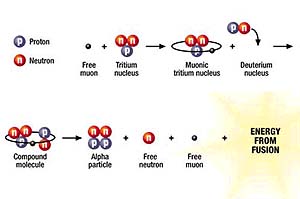
Muon-catalysed fusion has faced two big hurdles. Now an international team has cracked one of these, with a nifty way to bump up the number of nuclear reactions each muon achieves before it decays. Meanwhile, a group of Japanese physicists is making progress on the other. The muon aids fusion by first replacing an electron orbiting around a tritium nucleus--a heavy isotope of hydrogen--forming muonic tritium. If a deuterium nucleus is added, this creates a compound molecule. The muon, now orbiting the whole compound molecule, squeezes the two nuclei closer together until they fuse and become a helium nucleus, otherwise known as an alpha particle (click on thumbnail graphic for Diagram). Because the muon does the squeezing, there is no need for high temperatures and pressures. The researchers are reluctant to use the name "cold fusion" for their technique. "But it's colder than anything else going," says team leader Glen Marshall of the TRIUMF particle physics lab in Vancouver, British Columbia. In order to get a decent yield, the energy of the muonic tritium must be kept very low, about 1 electronvolt (eV), as it approaches the deuterium nuclei. In earlier work, researchers had used a scattergun approach, firing particles with different energies at a deuterium target. But Marshall's team discovered that muonic tritium escapes from a tritium-hydrogen mixture when its energy is about 1 eV. "That was a coincidental discovery," admits Marshall. "We used that fact to select atoms with the right kind of energy." The researchers fired their beam of 1 eV muonic tritium at concentrated deuterium condensed onto gold foil, and chilled the whole set-up to 3 kelvin. When they measured the number of fusions per muon by detecting the alpha particles produced, they clocked up a rate a hundred times as high as the scattergun approach. "It's a very interesting and important step," says Ken Nagamine at the Japanese Institute of Physics and Chemical Research (RIKEN) in Wako-shi. Nagamine's team is currently working on the other problem dogging muon fusion. In a reactor core each muon must catalyse about 300 fusions before its natural lifetime expires. The trouble is, the negatively charged muon tends to stick to the positive alpha particle at the end of the reaction. Nagamine says that the muon can break free under the right conditions. "We have discovered a process of high energy recoil of products which can strip the muon from the alpha particle." Source: Physics Review Letters (vol 85, p1674) This article appeared in the September 2 issue of New Scientist New Scientist. Copyright 2000 - All rights reserved. The material on this page is provided by New Scientist and may not be published, broadcast, rewritten or redistributed without written authorization from New Scientist. CommunityEmail This Article Comment On This Article Related Links Space
 Satellite Launch To Boost DTH In India
 Calcutta, India (SPX) Dec 28, 2005
The successful launch Thursday of India's heaviest satellite from spaceport of Kourou in French Guyana may have boosted the country's space research efforts to yet another level, but it has also lifted the spirits of at least three Direct-To-Home televisions broadcasters, one of which has been waiting for years to launch its services in India. |
|
|

|
|
|
|
|
|
|
|
|
|
|
|
| The content herein, unless otherwise known to be public domain, are Copyright 1995-2006 - SpaceDaily.AFP and UPI Wire Stories are copyright Agence France-Presse and United Press International. ESA PortalReports are copyright European Space Agency. All NASA sourced material is public domain. Additionalcopyrights may apply in whole or part to other bona fide parties. Advertising does not imply endorsement,agreement or approval of any opinions, statements or information provided by SpaceDaily on any Web page published or hosted by SpaceDaily. Privacy Statement |