|
 |
 |
 |
 |
 |
 |
 |
 |

 |
Do We Live In A "Stop And Go" Universe?
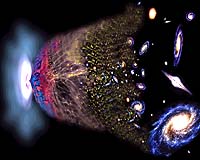
Boston - May 27, 2003 Anyone who drives is familiar with the frustration of being caught in "stop and go" traffic, a phenomenon found in urban areas all over the world. Astronomers have found that stop-and-go traffic is even more widespread than that, affecting galaxies throughout the universe. On Monday at the 202nd meeting of the American Astronomical Society, Robert Kirshner from the Harvard-Smithsonian Center for Astrophysics, and on behalf of the international High-z Supernova Search Team led by Brian Schmidt from Australia's Mount Stromlo Observatory, presented evidence that the expanding universe slowed for billions of years before galaxies began accelerating, like cars that get past a bottleneck. "Right now, the universe is speeding up, with galaxies zooming away from each other like Indy 500 racers hitting the gas when the green flag drops and the pace car gets out of their way. But we suspect that it wasn't always this way," said Kirshner. John Tonry (University of Hawaii), principal investigator of the team for the new and collected previous observations reported on today, agreed. "We've been hoping to see this effect of slowing in the distant past. We saw evidence 5 years ago that the expansion of the universe currently is accelerating, but we didn't know for sure what it was doing 7 billion years ago. We are now seeing hints that, way back then, the universe was slowing down." Astronomers discovered seven decades ago that the universe is expanding, with galaxies rushing away from each other in all directions. Physics suggested that the expansion, which began with the Big Bang, should slow down over time due to the combined gravitational pull from all matter in the cosmos. Two groups-the High-z Supernova Search Team and the Supernova Cosmology Project-sought to study the universe's expansion by observing distant exploding stars called Type Ia supernovae. At their peak, these explosions are brighter than a billion stars like the Sun, enabling astronomers to see and study them across billions of light-years of space. Five years ago, both teams announced that their studies of Type Ia supernovae showed the expansion of the universe is speeding up. The accelerating expansion pointed to the existence of an unexplained "dark energy" that permeates all of space. Those initial findings were based on a few dozen supernovae. Now, the High-z Supernova Search Team has expanded that work to 79 distant and 140 nearby supernovae, some newly observed and some previously studied by observers worldwide. The additional data show with higher precision that the discovery of five years ago was correct and the universe currently is accelerating. More importantly, Kirshner reported that Tonry and the High-z Supernova Search Team snagged four supernovae so distant that their light may well have left at a time when the universe was still slowing down, before dark energy began to dominate the gravitational pull of matter. Future plans include doubling the number of well-observed Type Ia supernovae through an ambitious program at the National Science Foundation's Cerro-Tololo Inter-American Observatory. The ESSENCE project (standing for "Equation of State: SupErNovae trace Cosmic Expansion") seeks to make an accurate measurement of the cosmic parameter w, which provides clues about the nature of the dark energy. The parameter w is defined as p/rho, the ratio of the dark energy's pressure to its energy density. "A better measurement of w will help answer the question: Is the dark energy Einstein's cosmological constant, or is it something else such as the so-called 'quintessence'?" said Chris Stubbs (University of Washington), one of the leaders of the ESSENCE project. "This is an important question considering that about 70 percent of the energy in the universe is dark energy, while only 30 percent is due to matter. Whatever dark energy is, it's the dominant stuff of the cosmos. We can't lose: No matter what we find, this will be interesting." Currently, the value of w is known only to within a factor of 2. The ESSENCE project will do 10 times better, reducing the level of uncertainty to plus or minus 10 percent. Adam Riess (Space Telescope Science Institute), as principal investigator for the Higher-z Supernova Search Team, is cooperating with the Great Observatories Origins Deep Survey (GOODS) to look for higher-redshift supernovae using the Hubble Space Telescope's Advanced Camera for Surveys (ACS). That program uses the ACS to find Type Ia supernovae at very large redshifts (and hence large distances), in order to look back even farther in time. The Higher-z project will have the best chance to determine whether the universe really was slowing down before cosmic acceleration kicked in. Community Email This Article Comment On This Article Related Links Paper Describing The Results Harvard-Smithsonian Center for Astrophysics SpaceDaily Search SpaceDaily Subscribe To SpaceDaily Express Nuclear Space Technology at Space-Travel.com
 JHU-STScI Team Maps Dark Matter In Startling Detail
 Baltimore MD (SPX) Dec 12, 2005
Clues revealed by the recently sharpened view of the Hubble Space Telescope have allowed astronomers to map the location of invisible "dark matter" in unprecedented detail in two very young galaxy clusters. |
|
|

| The content herein, unless otherwise known to be public domain, are Copyright 1995-2006 - SpaceDaily.AFP and UPI Wire Stories are copyright Agence France-Presse and United Press International. ESA PortalReports are copyright European Space Agency. All NASA sourced material is public domain. Additionalcopyrights may apply in whole or part to other bona fide parties. Advertising does not imply endorsement,agreement or approval of any opinions, statements or information provided by SpaceDaily on any Web page published or hosted by SpaceDaily. Privacy Statement |