|
 |
 |
 |
 |
 |
 |
 |
 |

 |
Do Pluto's Other Children Hide In The Shadow Of Charon
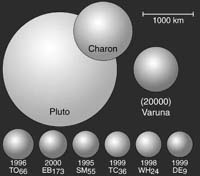
Boulder - Feb 25, 2003 Pluto has only one known satellite - Charon - discovered in 1978 by American astronomer James Christy. At slightly more than half the diameter of Pluto, Charon's 1,200-kilometer diameter makes it the undisputed "relative size" king of solar system satellites. In fact, Charon is so big compared to Pluto that the system's center of mass actually falls between the two bodies, making Pluto-Charon the only true binary planet in the solar system. Recently, astronomers have discovered that some large Kuiper Belt Objects also have large satellites. This, combined with the fact that previous searches for satellites around Pluto could have missed moons as large as hundreds of kilometers across, suggests to the New Horizons mission team that Pluto might have other, as-yet undiscovered satellites. "Discovering another moon or moons around Pluto-Charon would be exciting in and of itself, and could tell us a lot about the dynamical evolution of this unique, binary system," says New Horizons Principal Investigator Dr. Alan Stern of the Southwest Research Institute Space Studies Department, Boulder, Colo. "Whether or not we find new moons of Pluto, we expect to learn more about how and where Kuiper Belt satellites form. And, of course, any discoveries of new moons of Pluto would become targets of interest for the New Horizons flyby of the Pluto-Charon system." Therefore, the New Horizons project is organizing a search for additional satellites of Pluto. "It's something we plan to complete relatively quickly - that is, this year," says Dr. Harold Weaver, New Horizons deputy project scientist from The Johns Hopkins University Applied Physics Laboratory, Laurel, Md. "We will use both ground-based telescopes and, we hope, the Hubble Space Telescope." "With modern tools we should be able to determine if Pluto has any satellites larger than perhaps 10 or 20 kilometers across," Stern adds, "and do so with only a few days of telescope observing time." "The prospect that Pluto might have one or more, possibly even many satellites lurking about it is intriguing," Weaver says. "It is also important to know just how many satellites are in the system as part of our detailed mission planning activities." Community Email This Article Comment On This Article Related Links Pluto Mission SpaceDaily Search SpaceDaily Subscribe To SpaceDaily Express The million outer planets of a star called Sol
 Scientists Show Pluto To Be Colder Than It Should Be
 Cambridge MA (SPX) Jan 5, 2006
Mercury is boiling. Mars is freezing. The Earth is just right. When it comes to the temperatures of the planets, it makes sense that they should get colder the farther away they are from the Sun. But then there is Pluto. It has been suspected that this remote world might be even colder than it should be. Smithsonian scientists now have shown this to be true. |
|
|

| The content herein, unless otherwise known to be public domain, are Copyright 1995-2006 - SpaceDaily.AFP and UPI Wire Stories are copyright Agence France-Presse and United Press International. ESA PortalReports are copyright European Space Agency. All NASA sourced material is public domain. Additionalcopyrights may apply in whole or part to other bona fide parties. Advertising does not imply endorsement,agreement or approval of any opinions, statements or information provided by SpaceDaily on any Web page published or hosted by SpaceDaily. Privacy Statement |