|
 |
 |
 |
 |
 |
 |
 |
 |

 |
Distant Star Bursts Provide Key To The Origin Of Galaxies
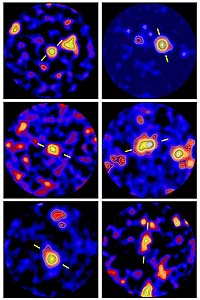
Edinburgh - Sep 19, 2003 Revealing images produced by one of the world's most sophisticated telescopes are enabling a team of Edinburgh astronomers to see clearly for the first time how distant galaxies were formed 12 billion years ago. Scientists from the UK Astronomy Technology Centre (UK ATC) and the University of Edinburgh have been targeting the biggest and most distant galaxies in the Universe with the world's most sensitive submillimetre camera, SCUBA. The camera, built in Edinburgh, is operated on the James Clerk Maxwell Telescope in Hawaii. The images, published in Nature tomorrow (18 September), reveal prodigious amounts of dust-enshrouded star formation which could ultimately tell scientists more about the formation of our own galaxy. It is thought these distant galaxies in the early Universe will evolve into the most massive elliptical galaxies seen at the present day. These giant galaxies consist of 1000 billion stars like our Sun and are found in large groups or clusters. Dr Jason Stevens, astronomer at the UK ATC in Edinburgh explained why understanding the evolution of these galaxies is so important. "The distant, youthful Universe was a very different place to the one we inhabit today. Billions of years ago, massive galaxies are thought to have formed in spectacular bursts of star formation. These massive elliptical galaxies have relatively simple properties. We hope that by understanding how simple galaxies form we will be one step closer to understanding how our own, spiral, Milky Way galaxy formed". Prof. Jim Dunlop, Head of the University of Edinburgh's Institute for Astronomy said: "For a long time astronomers have anticipated that the formation of the most massive galaxies should have been a spectacular event, but failed to find any observational evidence of massive galaxy formation from optical images. Now we have discovered that it is indeed spectacular, but because of the effects of interstellar dust, the spectacle is only revealed at submillimetre wavelengths." The dust absorbs the bright blue light emitted by young stars. The energy from the light heats the dust and makes it glow. It is this glow that is detected by the SCUBA camera. Dr Stevens and his colleagues suspected that these massive galaxies would form in particularly dense regions of space so they chose regions of very distant space that are known to be very dense because they contain massive radio galaxies - galaxies which emit high levels of radio waves. They found that many of the radio galaxies have near-by companion objects that had not previously been detected at any wavelength. Dr Rob Ivison, also at the UK ATC, described what they found. "The companion objects are located in the densest parts of the intergalactic medium, strung out like beads of water on a spider's web due to the filamentary structure of the Universe". The SCUBA images support a popular current model of galaxy formation in which today's massive elliptical galaxies were assembled in the early Universe in dense regions of space through the rapid merging of smaller building blocks. How do astronomers look back in time? The further light has to travel across the universe before it reaches the earth, the longer it takes to get here. That may sound obvious but it is very useful for astronomers. It means that when they look at objects in the furthest reaches of the universe, the light which is captured by the telescope and camera has taken most of the age of the universe to reach the earth. In other words they are also looking back in time to how the universe was shortly after it formed. However, it is not as easy as it sounds. On its way across the universe the light becomes stretched (because the universe is expanding) so that when it reaches the earth it is at much longer wavelengths than it was when it was originally emitted. This is known as 'red-shift'. The light from the star-forming galaxies in this study has been stretched so much that it has been shifted from the far-infrared waveband, accessible only from space, to the submillimetre waveband. Submillimetre radiation is emitted in the region of the electromagnetic spectrum which lies between infrared light and radio waves. Because it is absorbed by water vapour in the atmosphere it can only be detected from the Earth's highest mountains - in this case the 14,000ft Mauna Kea on Hawaii. The radiation that we detect is predominantly produced by a population of young hot young stars. This star-light is absorbed by small grains of graphite and silicate - 'interstellar dust' - and is re-radiated at longer far-infrared and submillimetre wavelengths. Community Email This Article Comment On This Article Related Links James Clerk Maxwell Telescope PPARC SpaceDaily Search SpaceDaily Subscribe To SpaceDaily Express Nuclear Space Technology at Space-Travel.com
 JHU-STScI Team Maps Dark Matter In Startling Detail
 Baltimore MD (SPX) Dec 12, 2005
Clues revealed by the recently sharpened view of the Hubble Space Telescope have allowed astronomers to map the location of invisible "dark matter" in unprecedented detail in two very young galaxy clusters.
--------------------------------------------------------- It's new. And it's downright terrific! Celestron's CPC Schmidt-Cassegrain telescope is the scope you've been waiting for! It offers new alignment technology, advanced engineering, and bold new design at a new, low price! In fact, Celestron's Professional Computerized (CPC) scope with revolutionary SkyAlign Alignment Technology redefines everything that amateur astronomers are looking for. It offers quick and simple alignment, GPS technology, unsurpassed optical quality, ease of use, advanced ergonomics, enhanced computerization and, most important, affordability. Want to view M-31 tonight? One button takes you there!
Shop for telescopes online at Telescopes.com! today!
|
|
|

| The content herein, unless otherwise known to be public domain, are Copyright 1995-2006 - SpaceDaily.AFP and UPI Wire Stories are copyright Agence France-Presse and United Press International. ESA PortalReports are copyright European Space Agency. All NASA sourced material is public domain. Additionalcopyrights may apply in whole or part to other bona fide parties. Advertising does not imply endorsement,agreement or approval of any opinions, statements or information provided by SpaceDaily on any Web page published or hosted by SpaceDaily. Privacy Statement |