|
 |
 |
 |
 |
 |
 |
 |
 |

 |
Discovery Supports Astronomers' Paradoxical Views Of The Universe
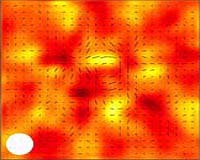
Chicago - Sep 23, 2002 The universe really is as surprising as scientists have come to suspect it is, according to a discovery that University of Chicago astrophysicists will announce Thursday, Sept. 19, at the COSMO-02 conference at Adler Planetarium and Astronomy Museum. The discovery, which astrophysicists have pursued with increasingly sensitive instruments for more than two decades, verifies the framework that supports modern cosmological theory. Using a radio telescope called the Degree Angular Scale Interferometer (DASI) at the National Science Foundation's Amundsen-Scott South Pole Station, the Chicago scientists measured a minute polarization of the cosmic microwave background, the sky-pervading afterglow of the big bang. Most light is unpolarized, its many individual waves jumbled together, each wave flickering up and down in a different plane as it speeds toward Earth. Unpolarized light becomes polarized whenever it is reflected or scattered. This is the principle behind polarizing sunglasses that remove the glare from the hood of a car or the surface of a pool. In both cases the sunglasses only permit waves that tend to flicker up and down in the same plane to pass. The polarization of the cosmic microwave background was produced by the scattering of cosmic light when it last interacted with matter, nearly 14 billion years ago. If no polarization had been found, astrophysicists would have to reject all their interpretations of the remarkable data they have compiled in recent years, said John Carlstrom, the S. Chandrasekhar Distinguished Service Professor in Astronomy & Astrophysics at the University of Chicago. "Instead of stating that we think we really understand the origin and evolution of the universe with high confidence, we would be saying that we just don't know," said Carlstrom, who will announce the discovery. "Polarization is predicted. It's been detected and it's in line with theoretical predictions. We're stuck with this preposterous universe." It's a universe in which ordinary matter, the stuff of which humans, stars and galaxies are made, accounts for less than five percent of the universe's total mass and energy. The vast majority of the universe, meanwhile, is made of a mysterious force that astronomers call "dark energy." This vague name reflects the fact that scientists simply do not know what it is. They only know that it acts in opposition to gravity, accelerating the expansion of the universe. In addition to the dark energy theory, cosmic inflation theory improbably proposes that the universe underwent a gigantic growth spurt in a fraction of a second just moments after the big bang. "This beautiful framework of contemporary cosmology has many things in it we don't understand, but we believe in the framework," said Clem Pryke, Assistant Professor in Astronomy & Astrophysics at the University of Chicago and a member of the DASI team. "This new result was a crucial test for the framework to pass." Carlstrom's other collaborators on the polarization discovery were John Kovac and Erik Leitch, University of Chicago; and Nils Halverson and Bill Holzapfel, University of California, Berkeley. The discovery follows in the wake of another important DASI finding. Last year Carlstrom's team precisely measured temperature differences in the cosmic microwave background, further supporting for the cosmic inflation theory. The polarization signal is more than 10 times fainter than the temperature differences that DASI detected earlier. DASI's first discovery came after it collected data for 92 days from 32 spots in the sky. But DASI needed to watch two spots in the sky for more than 200 days to detect the polarization. The discovery opens a new era in cosmic microwave background experiments, said the Chicago astrophysicists. They predict that increasingly sensitive detections of polarization will yield many more discoveries. "It's going to triple the amount of information that we get from the cosmic microwave background," said Kovac, a Ph.D. student in Physics. "It's like going from the picture on a black-and-white TV to color." The polarization is a signpost from when the universe was only 400,000 years old, when matter and light were only just beginning to separate from one another. "What's unique about polarization is that it directly measures the dynamics in the early universe," Carlstrom said. Temperature differences revealed patterns of lumpy matter frozen in the early universe, but by measuring polarization, astronomers can actually see how the early universe was moving. In the coming years, astronomers will attempt to use the CMB polarization to measure gravity waves, a form of radiation predicted by general relativity that corresponds to ripples in the fabric of space-time, said Michael Turner, the Bruce and Diana Rauner Distinguished Service Professor in Astronomy & Astrophysics at the University of Chicago. "Detection of the polarization opens a new door to exploring the earliest moments and answering the deep questions before us," Turner said. Community Email This Article Comment On This Article Related Links DASI polarization results SpaceDaily Search SpaceDaily Subscribe To SpaceDaily Express Nuclear Space Technology at Space-Travel.com
 JHU-STScI Team Maps Dark Matter In Startling Detail
 Baltimore MD (SPX) Dec 12, 2005
Clues revealed by the recently sharpened view of the Hubble Space Telescope have allowed astronomers to map the location of invisible "dark matter" in unprecedented detail in two very young galaxy clusters. |
|
|

| The content herein, unless otherwise known to be public domain, are Copyright 1995-2006 - SpaceDaily.AFP and UPI Wire Stories are copyright Agence France-Presse and United Press International. ESA PortalReports are copyright European Space Agency. All NASA sourced material is public domain. Additionalcopyrights may apply in whole or part to other bona fide parties. Advertising does not imply endorsement,agreement or approval of any opinions, statements or information provided by SpaceDaily on any Web page published or hosted by SpaceDaily. Privacy Statement |