|
 |
 |
 |
 |
 |
 |
 |
 |

 |
Discovery Sheds New Light On Cause Of Earthquakes
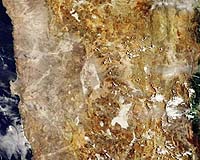
Liverpool, UK (SPX) Dec 14, 2006 Research at the University of Liverpool into a large fault zone in the Atacama Desert in northern Chile has produced new insight into how fluid pressure can cause earthquakes. Scientists have found how fluids, such as water, become sealed within the earth's fault planes for a long period of time. This fluid pressure makes it easier for the earth's plates to move alongside each other, eventually resulting in an earthquake. Dr Dan Faulkner explains: "The difficulty with predicting earthquakes is that we know so little about how fault planes work. Over the years we have found that even small stresses acting on the earth's plates can cause large earthquakes. For example the Loma Prieta earthquake in 1989 caused massive devastation, yet there was very little stress acting on the plate boundary to cause the quake in the first place. "In theory, high stresses are needed to cause slip along a fault plane, but if something like pressurised water or gas gets inside the fault then it should act as a kind of cushion, making movement between plates easier and an earthquake more likely. Until now a problem with this theory was that as fluid pressures increased the rocks would crack and the fluids could escape through the cracks, reducing the 'cushion' effect. Our recent study, however, found that much smaller cracks surrounding the fault plane change the stresses acting on the rock, reducing the likelihood of significant cracks forming and allowing the fluid to escape." The team measured the density of 'microcracks' in the rock near the Chile fault line and applied varying amounts of stress to the rock to see how it responded. They found the 'microcracks' changed the elasticity of the rock, which meant stresses that might normally occur at almost right angles to the fault line rotated to a 45 degree angle instead. Under normal stresses fluid would build up to such as extent that the rock would break and the fluid would escape, reducing the risk of an earthquake. When stress, however, occurs at a 45 degree angle the rock is less likely to break and the low fluid pressures inside can cause earthquakes. Dr Faulkner added: "We now need to conduct further study into where these fluids and gases are coming from. Scientists are currently drilling of the San Andreas Fault in California, to help us understand more fully the mechanics of fault zones and how earthquakes occur." The San Andreas Fault Observatory at Depth (SAFOD) is a deep borehole observatory that will measure the physical conditions under which plate boundary earthquakes occur. Dr Faulkner is one of only two UK scientists who currently have access to rock drilled from the San Andreas Fault, which will be analysed in order to understand fault behaviour. Community Email This Article Comment On This Article Related Links University of Liverpool When the Earth Quakes Bringing Order To A World Of Disasters When the Earth Quakes A world of storm and tempest
 Kenya Flood Toll Surges To 114
 Nairobi (AFP) Dec 11, 2006
Massive flooding in Kenya has killed at least 114 people and affected more than 700,000 others over the past six weeks, the Kenyan Red Cross said Monday, more than doubling its earlier death toll. "This is the new figure we shall be using from now on," Kenya Red Cross Society (KRCS) spokesman Anthony Mwangi told AFP, adding that the number was based on its own nationwide survey as well as local media reports. |
|
|

| The content herein, unless otherwise known to be public domain, are Copyright 1995-2006 - SpaceDaily.AFP and UPI Wire Stories are copyright Agence France-Presse and United Press International. ESA PortalReports are copyright European Space Agency. All NASA sourced material is public domain. Additionalcopyrights may apply in whole or part to other bona fide parties. Advertising does not imply endorsement,agreement or approval of any opinions, statements or information provided by SpaceDaily on any Web page published or hosted by SpaceDaily. Privacy Statement |