|
 |
 |
 |
 |
 |
 |
 |
 |

 |
Discovery Crew Leaves ISS For Earth
Houston TC (AFP) Dec 19, 2006 Astronauts aboard the Discovery space shuttle undocked from the International Space Station Tuesday to begin the journey back to Earth after an eight day construction visit. The shuttle pulled away at 2210 GMT nearly a half hour after the hatch to the ISS was shut. According to plans, co-pilot William Oefelein will slowly manually steer the shuttle 200 meters off the ISS and toward its middle to take photographs and film of it. The undocking followed a busy slate of space walks to rewire and install new equipment on the orbiting ISS, and came a day later than planned after NASA added a fourth, unscheduled walk to unstick a balky solar panel. The seven-man shuttle crew will return to Earth then on Friday, a day later than on the original mission schedule. The return crew on discovery includes European Space Agency astronaut Thomas Reiter, going back to Earth after five months at the ISS. Staying behind in his place is US astronaut Sunita Williams, who will join two others already at the station. The Discovery is scheduled to return to Earth at 2056 GMT Friday, the National Aeronautics and Space Administration announced, with the landing planned for Kennedy Space Center at Cape Canaveral, Florida, where it first departed in a nighttime launch on December 11. "We are going to say a farewell to the Discovery crew," ISS commander Michael Lopez-Alegria as the hatch was shut. "I think all of us will declare this mission successful." "I am excited to go back to the ground," said Reiter, adding that he had a "very exciting, enjoyable time" at the ISS. John Curry, flight director ISS, said all three main objectives of the mission had been accomplished: the installation of a two-tonne truss to the girder-like ISS structure, the reconfiguration of the power and thermal systems to a permanent system, and the retraction of a solar array to allow a new panel to rotate to collect solar energy. "It's another great day in space," Curry said. In the additional walk Monday, two astronauts managed to free the array so that it could be retracted into its box and replaced with a new energy-generating panel. Mission specialists Robert Curbeam and Christer Fuglesang, a Swedish astronaut of the European Space Agency, spent six and a half hours working outside the ISS Monday to fix the stuck panel. Curbeam and Fuglesang used several makeshift tools, including a scraper and a hook, to pull guide wires, push panel hinges and shake the solar array to free it. They also had to be careful not to damage the sensitive panels. Curbeam set a new NASA record for an astronaut by making four space walks during a single mission. The decision to delay the landing until Friday halves the shuttle's two-day safety cushion for return to Earth. Discovery will only have one day's supply of oxygen and electrical power left, requiring a landing by Saturday at the latest. Including the current Discovery mission, NASA has planned 14 shuttle flights to complete construction of the ISS by 2010, when the shuttle fleet, down to three vehicles, is to be retired.
earlier related report A US astronaut on the space station has switched places with a member of the seven-person Discovery crew and will travel back to Earth on the orbiter. The landing is expected Friday. In an additional, fourth spacewalk Monday, two astronauts managed to retract all the panels of a solar array whose mechanism had become stuck. "We finished all the mission objectives so we are very pleased. It's a great day for the ISS program and the shuttle program," Kirk Shireman, deputy manager of the ISS program, said at a news conference late Monday. John Curry, flight director ISS, said all three main objectives of the mission had been accomplished: the installation of a two-tonne truss to the girder-like ISS structure, the reconfiguration of the power and thermal systems to a permanent system, and the retraction of a solar array to allow a new solar array to rotate to collect solar energy. "It's another great day in space," Curry said. In the final space walk, mission specialists Robert Curbeam and Christer Fuglesang, a Swedish astronaut of the European Space Agency, spent six and a half hours working outside the ISS, ending their mission at 0138 GMT Tuesday. "Great job by everybody up there and down here on the ground," said astronaut Steve Robinson, speaking from the Mission Control Center in Houston. "We do have (a) confirmed latch," he said, when the panel was fully folded like an accordion into its storage boxes. Curbeam set a new NASA record for an astronaut by making four space walks during a single mission. Curbeam and Fuglesang used several tools, including a scraper and a hook, to pull guide wires, push panel hinges and shake the solar array to free it. They also had to be careful not to damage the sensitive panels. The station, when completed, will have four solar arrays to supply it with electricity. NASA extended Discovery's mission by a day to shake loose the panel array, which stuck nearly half-way when it was being folded last Wednesday. The solar array, which supplies power to the ISS, was replaced with a new, more powerful solar panel array, which extended earlier without trouble. The old panels later will be set up in a different part of the station. The decision to delay the landing until Friday halves the shuttle's two-day safety cushion for return to Earth: the space craft will only have one day's supply of oxygen and electrical power left, requiring a landing by Saturday at the latest. Including the current Discovery mission, NASA has planned 14 shuttle flights to complete the ISS by 2010, when the shuttle fleet, down to three vehicles, is to be retired. Discovery and its seven-member crew blasted off last Saturday from Cape Canaveral, Florida, in the first nighttime liftoff in four years. The shuttle is expected to land around 2100 GMT Friday in Florida.
earlier related report US astronaut Robert Curbeam, together with Sweden's Christer Fuglesang, spent six and a half hours working outside the ISS, ending their mission at 0138 GMT Tuesday. "Great job by everybody up there and down here on the ground," said astronaut Steve Robinson, speaking from Mission Control in Houston. "We do have (a) confirmed latch," he said, when the panel was fully folded like an accordion into its storage boxes. NASA extended the Discovery's mission by a day after failing to shake loose the panel array, which stuck nearly half-way when it was being folded on Wednesday. The solar array, which supplies power to the ISS, was replaced with a new, more powerful solar panel array, which extended earlier without trouble. The old panels will be later set up in a different part of the station. Besides shaking, tugging and pushing on the array from inside and outside the ISS, on Friday NASA engineers in Houston asked German astronaut Thomas Reiter to exercise vigorously for 30 seconds on the ISS's training machine, hoping his vibrations would loosen the stuck array panels. Reiter, who is at the end of a five-month stay on the ISS, tried several times to shake the array into action but was unsuccessful. On a space walk Saturday, the astronauts completed a delicate rewiring of the space station but were again unable to fix the jammed array. That led to a decision to add one more walk to the schedule, and to extend Discovery's mission by one day. The decision to delay the landing until Friday however halves the shuttle's two-day safety cushion for return to Earth: the space craft will only have one day's supply of oxygen and electrical power left, requiring a landing by Saturday at the latest. During Monday's space walk, Curbeam and Fuglesang used several tools, including a scraper and a hook, to pull guide wires, push panel hinges and shake the array to free it. They also had to be careful not to damage the sensitive panels. The station, when completed, will have four solar arrays to supply it with electricity. Including the current Discovery mission, NASA has planned 14 shuttle flights to complete the ISS by 2010, when the shuttle fleet, down to three vehicles, is to be retired. Discovery and its seven-member crew blasted off last Saturday from Cape Canaveral, Florida, in the first nighttime liftoff in four years. The shuttle is scheduled to separate from the International Space Station around 2200 GMT Tuesday. On Wednesday the astronauts will likely inspect the ship's heat shielding for a second time, then depart towards the Earth. If all goes according to plan the shuttle will land around 2100 GMT Friday in Florida, but if weather is bad they may land at Edwards Air Force Base in California.
Source: Agence France-Presse Community Email This Article Comment On This Article Related Links Shuttle and Station at NASA Space Station News at Space-Travel.Com Space Shuttle News at Space-Travel.Com Space Station News at Space-Travel.Com
 Spacewalk Completes Solar Array Retraction
 Houston TX (SPX) Dec 19, 2006
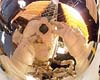
During a spacewalk lasting over six and a half hours, ESA astronaut Christer Fuglesang and NASA's Robert Curbeam successfully freed the International Space Station's jammed P6 solar array allowing it to fully retract. Standing on the end of the Station's robotic arm, Canadarm2, Curbeam used tape-insulated tools to pull on the array's guide wires, whilst Fuglesang shook the panel several times. Gradually the solar array was fully retracted into its rectangular blanket box. |
|
|

| The content herein, unless otherwise known to be public domain, are Copyright 1995-2006 - SpaceDaily.AFP and UPI Wire Stories are copyright Agence France-Presse and United Press International. ESA PortalReports are copyright European Space Agency. All NASA sourced material is public domain. Additionalcopyrights may apply in whole or part to other bona fide parties. Advertising does not imply endorsement,agreement or approval of any opinions, statements or information provided by SpaceDaily on any Web page published or hosted by SpaceDaily. Privacy Statement |