|
 |
 |
 |
 |
 |
 |
 |
 |

 |
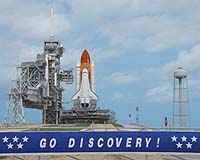
Discovery At The Pad For October 23 Launch
Cape Canaveral FL (SPX) Oct 01, 2007 Space shuttle Discovery arrived at Launch Pad 39A at NASA's Kennedy Space Center, resting on the hardstand by 1:15 p.m. The shuttle began its slow 3.4-mile journey to the pad atop the crawler transporter at 6:47 a.m., leaving the Vehicle Assembly Building in the early morning darkness. Also at the pad is the payload canister containing the Harmony module that the STS-120 crew will deliver to the International Space Station. Harmony will be installed in Discovery's payload bay as launch preparations continue at the pad. Discovery and its seven astronaut crew are targeted to launch Oct. 23 on the STS-120 mission to the International Space Station.
STS-120 Bringing Space Station Harmony The pressurized component was named "Harmony" by U.S. students in a nationwide contest. "This module will allow all international partner pieces of the station to connect together, so it's really wonderful that kids recognize that harmony is necessary for space cooperation," said Bill Gerstenmaier, NASA's associate administrator for space operations, when the six winning schools who submitted the name were announced. The module will be the connecting point between the U.S. Destiny lab, the European Space Agency's Columbus module and the Japanese Kibo module. Harmony's delivery to the station sets the stage for the following two space shuttle flights that will carry the Columbus and Kibo components to the station. Those laboratory modules have been prepared side by side with Harmony in the high bay of the Space Station Processing Facility at NASA's Kennedy Space Center in Florida. Harmony was delivered to Florida in 2003 aboard an Airbus Beluga aircraft. "The first thing we did was a post-delivery inspection and checkout to make sure the ferry flight from Italy to Florida didn't cause any damage to the module," said Glenn Chin, the payload mission manager for STS-120. Since then, a team of technicians has worked to prepare it for flight. Weighing 31,500 pounds when loaded for flight, the 21-foot-long component will be parked in a temporary spot on the space station by the STS-120 crew, since the docked shuttle will be occupying Harmony's permanent spot. Later, the space station crew will relocate the module to its permanent location. Harmony will be the fourth named U.S. module on the station, taking its place with the Destiny laboratory, the Quest airlock and the Unity node. "Harmony has been here with us for four years," explained Chin. "We've been working hard getting it ready for flight, and we've finally come to this stage of getting it ready to be put into the orbiter." Before each mission, the astronauts who will deliver the space station element spend time inside the Space Station Processing Facility. "We had the crew here on about four different occasions" inspecting the module they will install on the orbiting outpost, says Chin. While the excitement for the launch builds among those who have been working on the module since its arrival, there are also some mixed feelings about seeing it depart for its final destination. "It's an exhilarating feeling of excitement and we're all anxious to see Harmony get to the pad," said Chin. "I've never been a mission manager for any other mission that was as challenging." But even with all the excitement of the upcoming mission, he added that after working with the module for four years, "we'll definitely miss Harmony." Community Email This Article Comment On This Article Related Links STS-120 Mission Overview Observation Deck Shuttle at NASA Watch NASA TV via Space.TV Space Shuttle News at Space-Travel.Com
 Strut repairs could delay shuttle launch: NASA
 Washington (AFP) Sept 18, 2007
A leaking hydraulic seal on the space shuttle Discovery's right main-gear strut could delay the launch of the shuttle to the International Space Station set for October 23, NASA said Monday. |
|
|

| The content herein, unless otherwise known to be public domain, are Copyright 1995-2007 - SpaceDaily.AFP and UPI Wire Stories are copyright Agence France-Presse and United Press International. ESA Portal Reports are copyright European Space Agency. All NASA sourced material is public domain. Additional copyrights may apply in whole or part to other bona fide parties. Advertising does not imply endorsement,agreement or approval of any opinions, statements or information provided by SpaceDaily on any Web page published or hosted by SpaceDaily. Privacy Statement |