|
 |
 |
 |
 |
 |
 |
 |
 |

 |
Discovery Astronauts Begin Spacewalk To Rewire ISS
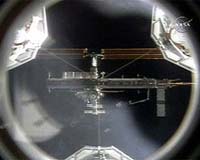
Houston (AFP) Texas, Dec 14, 2006 Two Discovery astronauts Thursday began the second spacewalk of the 12-day space shuttle mission to rewire the International Space Station, NASA said. Mission specialist Robert Curbeam and Christer Fuglesang, Sweden's first astronaut, stepped outside the ISS at 1941 GMT, about 20 minutes ahead of time, the US space agency said. During the next six hours, the pair is to rewire the ISS to adapt it to a new solar array that will double its power output. The delicate and potentially risky work involves shutting off the electricity to half the space station to prevent the astronaut-electricians from getting electrocuted. However, the ISS will still be fully powered as the electricity from the functioning side will be rerouted to the other, inactive half. A third and final spacewalk is scheduled for Saturday, when Curbeam and mission specialist Sunita Williams will finish the work begun Thursday and install a camera on the ISS to facilitate future construction work on the space station. NASA has not ruled out a fourth spacewalk to fully retract a six-year-old solar array on the ISS to allow the sun-tracking rotation of a new solar array installed during an Atlantis mission in September. The new array should be activated once the ISS is properly rewired. The older solar array on Wednesday was partially retracted -- its wings folded like an accordion -- by remote control from inside the ISS when the system jammed. NASA, however, deemed the array was sufficiently retracted to allow the new solar array to rotate its solar cells to face the sun. It was unclear whether the 12-day Discovery mission would be extended in case a fourth spacewalk is needed to retract the old array manually and reposition it. The girder-like ISS is being assembled piece by piece. Construction resumed in September with the Atlantis mission, after a three-year hiatus following the 2003 Columbia disaster. The Discovery mission is part of 14 shuttle flights NASA has planned over the next four years to finish the ISS by 2010, when the shuttle fleet, down to three vehicles, is to be retired. Discovery blasted off late Saturday from Cape Canaveral, Florida -- the first nighttime liftoff in four years. It docked on the station Monday and is to remain there eight days. Its return to Earth is scheduled on December 21. National Aeronautics and Space Administration engineers said two preliminary inspections carried out after takeoff and shortly before Discovery docked with the ISS found no damage to the Discovery's heat shield during launch. Such inspections on the shuttles have become routine since the Columbia tragedy. Columbia's heat shield was pierced by foam insulation that peeled off its fuel tank during liftoff, causing the shuttle to disintegrate during its return to Earth in February 1, 2003, killing all seven astronauts on board.
Source: Agence France-Presse Community Email This Article Comment On This Article Related Links Space Station News at Space-Travel.Com Space Shuttle News at Space-Travel.Com Space Station News at Space-Travel.Com
 Astronauts Wrestle With Kink On Space Station Solar Array
 Houston TX (SPX) Dec 14, 2006
Astronauts on space shuttle Discovery and the International Space Station grappled Wednesday with a balky solar array in preparation of two spacewalks to rewire the orbiting laboratory. On Tuesday, a pair of Discovery astronauts installed a two-tonne truss on the ISS during the first of three space walks in the 12-day mission that began Saturday. Astronauts on Wednesday were trying to retract a 115-foot (35-meter) solar array on the ISS that had been unfurled for more than six years, when they encountered a kink, NASA said. |
|
|

| The content herein, unless otherwise known to be public domain, are Copyright 1995-2006 - SpaceDaily.AFP and UPI Wire Stories are copyright Agence France-Presse and United Press International. ESA PortalReports are copyright European Space Agency. All NASA sourced material is public domain. Additionalcopyrights may apply in whole or part to other bona fide parties. Advertising does not imply endorsement,agreement or approval of any opinions, statements or information provided by SpaceDaily on any Web page published or hosted by SpaceDaily. Privacy Statement |