|
 |
 |
 |
 |
 |
 |
 |
 |

 |
Disaster Monitoring Constellation Partners Hold 4th Meeting
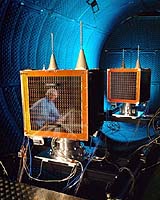
Ankara - Dec 14, 2003 Following the successful launch of the latest three satellites forming the Disaster Monitoring Constellation, the international partners in the constellation held their fourth meeting, hosted by BILTEN (Turkey) in Ankara, 17-18 November. The busy two-day meeting reached agreements concerning orbit phasing, establishing the ground segment and data processing systems, and integrating the mission planning systems. Representatives from CNTS (Algeria), NASRDA (Nigeria), SSTL (UK), Reuters AlertNet (UK), Tubitak Bilten (Turkey) and CCSTA/NCST (Vietnam) participated in the meeting. The first year of operations of AlSAT-1 were reviewed by the satellite operator, Centre National Techniques Spatiales, who reported that demands for DMC image data from government departments have far exceeded their expectations. The first results from the latest three DMC satellites for Nigeria, Turkey and the UK, launched on 27 September 2003, were also presented. A fifth DMC satellite, currently under construction at SSTL for China, is due to be launched in early 2005. Currently the four DMC satellites in orbit are being manoeuvred into their constellation positions and a daily imaging service is planned to commence in the spring of 2004. The next DMC meeting will be hosted by SSTL at the Surrey Space Centre, UK, during the summer of 2004. The Disaster Monitoring Constellation (DMC) is a novel international co-operation in space, led by SSTL bringing together organisations from five countries: Algeria, China, Nigeria, Turkey and the United Kingdom. The DMC Consortium has formed the first-ever microsatellite constellation bringing remarkable Earth observation capabilities both nationally to the individual satellite owners, and internationally to benefit world-wide humanitarian aid efforts. The DMC is an innovative concept designed by SSTL, which brings together a unique partnership of nations and provides a sustainable space programme for nations who might otherwise be unable to afford their own independent space capability. As collaborative partners these countries are able to reap the benefits of sharing a powerful resource -- not just one satellite but five. Each partner is able to operate completely independently, but may also share unused capacity with other partners to gain the benefit of daily Earth imaging. They also enjoy greater flexibility in down-linking data through other ground stations around the world when required. The first satellite in the DMC, AlSAT-1 for Algeria, was launched on 28 November 2002 and a further three satellites -- NigeriaSat-1 (Nigeria), BILSAT-1 (Turkey) and UK-DMC -- were launched on 27 September 2003. All four satellites are fully operational in orbit, delivering outstanding Earth observation imagery. The spacecraft were all built at the Surrey Space Centre in Guildford. Those for Algeria, Nigeria and Turkey were built under know-how transfer and training programmes, whereby a team of engineers from each country spent 18 months at Surrey working alongside SSTL engineers. A fifth satellite for China, DMC+4, is currently under construction at the Surrey Space Centre for launch early 2005. Each satellite, weighing some 90 kg, provides 32-metre multispectral Earth observation imaging, covering a vast 600 x 600 km area anywhere on the Earth's surface. The images cover ten times more area compared with images of less than 200 x 200 km currently available from other civilian Earth observation satellites. Also unique is the ability to re-image anywhere on the Earth's surface within 24-hours -- something not achievable by any other satellite currently in-orbit. These powerful resources place the DMC in a distinctive position to provide Earth observation images to the international disaster relief community in partnership with Reuters AlertNet. The International Disaster Monitoring Constellation is a further example of a new generation of advanced small satellites pioneered by SSTL -- providing outstanding capability at low cost. The DMC is now demonstrating how a network of small satellites can work together to provide valuable operational services at exceptionally low cost. Community Email This Article Comment On This Article Related Links DMC at Surrey Satellite SpaceDaily Search SpaceDaily Subscribe To SpaceDaily Express Earth Observation News - Suppiliers, Technology and Application
 New Legislation Initiated To Support Commercial Remote Sensing Industry
 New York NY (SPX) Jan 11, 2006
The importance of remotely sensed data and technologies to support natural disasters has prompted attention and action in Washington. New initiatives and legislation authorizing appropriations to the remote sensing industry will be discussed at Strategic Research Institute's U.S. Commercial Remote Sensing Industry conference, scheduled for February 9-10, 2006 in Washington D.C. |
|
|

| The content herein, unless otherwise known to be public domain, are Copyright 1995-2006 - SpaceDaily.AFP and UPI Wire Stories are copyright Agence France-Presse and United Press International. ESA PortalReports are copyright European Space Agency. All NASA sourced material is public domain. Additionalcopyrights may apply in whole or part to other bona fide parties. Advertising does not imply endorsement,agreement or approval of any opinions, statements or information provided by SpaceDaily on any Web page published or hosted by SpaceDaily. Privacy Statement |