|
 |
 |
 |
 |
 |
 |
 |
 |

 |
Dinosaurs Died Within Hours After Asteroid Hit Earth
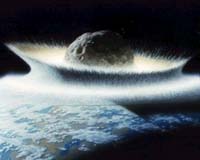
Boulder CO (SPX) May 26, 2004 According to new research led by a University of Colorado at Boulder geophysicist, a giant asteroid that hit the coast of Mexico 65 million years ago probably incinerated all the large dinosaurs that were alive at the time in only a few hours, and only those organisms already sheltered in burrows or in water were left alive. The six-mile-in-diameter asteroid is thought to have hit Chicxulub in the Yucatan, striking with the energy of 100 million megatons of TNT, said chief author and Researcher Doug Robertson of the department of geological sciences and the Cooperative Institute for Research in Environmental Sciences. The "heat pulse" caused by re-entering ejected matter would have reached around the globe, igniting fires and burning up all terrestrial organisms not sheltered in burrows or in water, he said. A paper on the subject was published by Robertson in the May-June issue of the Bulletin of the Geological Society of America. Co-authors include CU-Boulder Professor Owen Toon, University of Wyoming Professors Malcolm McKenna and Jason Lillegraven and California Academy of Sciences Researcher Sylvia Hope. "The kinetic energy of the ejected matter would have dissipated as heat in the upper atmosphere during re-entry, enough heat to make the normally blue sky turn red-hot for hours," said Robertson. Scientists have speculated for more than a decade that the entire surface of the Earth below would have been baked by the equivalent of a global oven set on broil. The evidence of terrestrial ruin is compelling, said Robertson, noting that tiny spheres of melted rock are found in the Cretaceous-Tertiary, or KT, boundary around the globe. The spheres in the clay are remnants of the rocky masses that were vaporized and ejected into sub-orbital trajectories by the impact. A nearly worldwide clay layer laced with soot and extra-terrestrial iridium also records the impact and global firestorm that followed the impact. The spheres, the heat pulse and the soot all have been known for some time, but their implications for survival of organisms on land have not been explained well, said Robertson. Many scientists have been curious about how any animal species such as primitive birds, mammals and amphibians managed to survive the global disaster that killed off all the existing dinosaurs. Robertson and colleagues have provided a new hypothesis for the differential pattern of survival among land vertebrates at the end of the Cretaceous. They have focused on the question of which groups of vertebrates were likely to have been sheltered underground or underwater at the time of the impact. Their answer closely matches the observed patterns of survival. Pterosaurs and non-avian dinosaurs had no obvious adaptations for burrowing or swimming and became extinct. In contrast, the vertebrates that could burrow in holes or shelter in water -- mammals, birds, crocodilians, snakes, lizards, turtles and amphibians -- for the most part survived. Terrestrial vertebrates that survived also were exposed to the secondary effects of a radically altered, inhospitable environment. "Future studies of early Paleocene events on land may be illuminated by this new view of the KT catastrophe," said Robertson. Community Email This Article Comment On This Article Related Links University of Colorado at Boulder SpaceDaily Search SpaceDaily Subscribe To SpaceDaily Express Asteroid and Comet Impact Danger To Earth - News and Science
 A Comet's Only Cameraman
 Moffett Field CA (SPX) Aug 12, 2005
Digital effects artist Dan Maas has a vision that " small teams... create works of spectacular scope and great complexity", a dream that he has now shown the world both on Mars and a comet. |
|
|

| The content herein, unless otherwise known to be public domain, are Copyright 1995-2006 - SpaceDaily.AFP and UPI Wire Stories are copyright Agence France-Presse and United Press International. ESA PortalReports are copyright European Space Agency. All NASA sourced material is public domain. Additionalcopyrights may apply in whole or part to other bona fide parties. Advertising does not imply endorsement,agreement or approval of any opinions, statements or information provided by SpaceDaily on any Web page published or hosted by SpaceDaily. Privacy Statement |