|
 |
 |
 |
 |
 |
 |
 |
 |

 |
Digital Divide: Political Will And Space Solutions
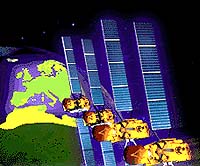
Luxembourg (ESA) Oct 18, 2004 Space can help to bridge the digital divide; this was the clear message of the Luxembourg colloquium 'On the road to Lisbon', dedicated to the knowledge-based economy from the European perspective, held last week in the Grand Duchy. In Lisbon, in March 2000, the European Council set the objective of ensuring that Europe becomes "the most competitive and dynamic knowledge-based economy in the world, capable of sustainable economic growth". To reach this goal it is particularly urgent to bridge the so-called digital divide. A workshop organised by ESA focussed on how space solutions can help reduce the inequities in the access to new technologies within an enlarged Europe. A round table reviewed the different sides of this theme and looked at the advantages and constraints of space solutions. "The digital divide will accentuate the social divide if no measures are taken, though new technologies could help us fill this social divide" said Francois Biltgen, Luxembourg's minister for culture and research, taking part in the round table. Obstacles are well identified: the cost is currently too high but can be lowered. "A technological effort must allow acceptable prices, at levels comparable with terrestrial solutions today," explained Didier Faivre, from ESA's Directorate of European Union and Industry Programmes in ESA, "especially since the technologies needed exist or are already being developed." Another barrier is regulation. As emphasised by Romain Bausch, CEO of the satellite operator SES Global, "While in the United States there is only one regulatory authority, in Europe there are no rules at the Union level, but national rules at every level, for frequencies as well as for authorisations for two-way broadcasting". But the advantage of a satellite is its coverage over Europe and beyond. Thus there is a gap between satellite potential and the applications. For access to broadband, used for services such as Internet, in Europe today there are no big distribution channels for satellites, only several small companies, or the existing network supplied by the classic telecom operators, who have a tendency to favour terrestrial solutions. This also raises the question of public support to implement an efficient system. Romain Bausch thinks that subsidies must be dedicated to content rather than infrastructures, for which he feels that bank guarantees would be more helpful. "The digital divide is also a civic divide" added Catherine Trautman, Member of European parliament and former French minister of culture and communication. Beyond the problem of access there is the added problem of education in the use of these new technologies: "Europe must allocate resources for equity of access but also in equipment and in education� stated Catherine Trautman. The political will is at stake for European institutions, which must also take into consideration the fact that satellite systems are less vulnerable than terrestrial ones and, most importantly, are the only solutions available in crisis situations. Furthermore, suggested by Minister Biltgen, these integrated services over Europe could also be extended to less advanced countries and fully participate to the European support for development. The problem is not just a technical one, and satellites are not a miracle cure. They are just one part of the solution. This is why ESA does not want to act alone but to develop satellite systems well fitted to the needs and realities of Europe. In this context ESA wishes to propose at its next ministerial conference, at the end of 2005, a programme federating space solutions to help to bridge the digital divide, in partnership with the European Commission. Concrete examples show what ESA is able to initiate: Eutelsat, a private company, was born from the ECS satellites, while Eumetsat, came out of the first Meteosat meteorological satellites - innovative ideas which became operational, indispensable and also profitable services. Community Email This Article Comment On This Article Related Links ESA Telecom Sitec (LU) Henri Tudor Research Centre (LU) SpaceDaily Search SpaceDaily Subscribe To SpaceDaily Express Satellite-based Internet technologies
 iPod Dominance A Mirage
 Chicago (UPI) Jan 09, 2006
Though Apple Computer has reported remarkable success with its iPod - sales rose by 250 percent during the last fiscal year - there is some competition coming this week for the developer of the world's most famous, legitimate music downloading network, experts tell United Press International's Networking. |
|
|

| The content herein, unless otherwise known to be public domain, are Copyright 1995-2006 - SpaceDaily.AFP and UPI Wire Stories are copyright Agence France-Presse and United Press International. ESA PortalReports are copyright European Space Agency. All NASA sourced material is public domain. Additionalcopyrights may apply in whole or part to other bona fide parties. Advertising does not imply endorsement,agreement or approval of any opinions, statements or information provided by SpaceDaily on any Web page published or hosted by SpaceDaily. Privacy Statement |