|
 |
 |
 |
 |
 |
 |
 |
 |

 |
Digital Dandelions: The Flowering Of Network Research
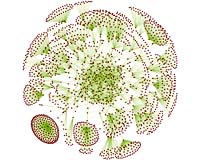
San Diego CA (SPX) Sep 06, 2007 What looks like the head of a digital dandelion is a map of the Internet generated by new algorithms from computer scientists at UC San Diego. This map features Internet nodes - the red dots - and linkages - the green lines. But it is no ordinary map. It is a (mostly) randomly generated graph that retains the essential characteristics of a specific corner of the Internet but doubles the number of nodes. On August 30 in Kyoto, Japan at ACM SIGCOMM, the premier computer networking conference, UCSD computer scientists presented techniques for producing annotated, Internet router graphs of different sizes - based on observations of Internet characteristics. The graph annotations include information about the relevant peer-to-peer business relationships that help to determine the paths that packets of information take as they travel across the Internet. Generating these kinds of graphs is critical for a wide range of computer science research. "Defending against denial of service attacks and large-scale worm outbreaks depends on network topology. Our work allows computer scientists to experiment with a range of random graphs that match Internet characteristics. This work is also useful for determining the sensitivity of particular techniques - like routing protocols and congestion controls - to network topology and to variations in network topology," said Priya Mahadevan, the first author on the SIGCOMM 2007 paper. Mahadevan just completed her computer science Ph.D. at UCSD's Jacobs School of Engineering. In October, she will join Hewlett Packard Laboratories in Palo Alto, CA. "We're saying, 'here is what the Internet looks like, and here is our recreation of it on a larger scale.' Our algorithm produces random graphs that maintain the important interconnectivity characteristics of the original. The goal is to produce a topology generator capable of outputting a range of annotated Internet topologies of varying sizes based on available measurements of network connectivity and characteristics," said Amin Vahdat, the senior author on the paper, a computer science professor at UCSD and the Director of UCSD's Center for Networked Systems (CNS) - an industrial/academic collaboration investigating emerging issues in computing systems that are both very large (planetary scale) and very small (the scale of wireless sensor networks). The authors are making the source code for their topology generator publicly available and hope that it will benefit a range of studies. "The techniques we have developed for characterizing and recreating Internet characteristics are generally applicable to a broad range of disciplines that consider networks, including physics, biology, chemistry, neuroscience and sociology," said Vahdat. The authors on the SIGCOMM paper "Orbis: Rescaling Degree Correlations to Generate Annotated Internet Topologies," are Priya Mahadevan, Calvin Hubble and Amin Vahdat from UCSD's Department of Computer Science and Engineering; and Bradley Huffaker and Dimitri Krioukov from CAIDA, the Cooperative Association for Internet Data Analysis which is based at the University of California's San Diego Supercomputer Center. Community Email This Article Comment On This Article Related Links Satellite-based Internet technologies
 Researchers Aim To Make Internet Bandwidth A Global Currency
 Boston MA (SPX) Aug 30, 2007
Computer scientists at Harvard's School of Engineering and Applied Sciences, in collaboration with colleagues from the Netherlands, are using a novel peer-to-peer video sharing application to explore a next-generation model for safe and legal electronic commerce that uses Internet bandwidth as a global currency. |
|
|

| The content herein, unless otherwise known to be public domain, are Copyright 1995-2007 - SpaceDaily.AFP and UPI Wire Stories are copyright Agence France-Presse and United Press International. ESA Portal Reports are copyright European Space Agency. All NASA sourced material is public domain. Additional copyrights may apply in whole or part to other bona fide parties. Advertising does not imply endorsement,agreement or approval of any opinions, statements or information provided by SpaceDaily on any Web page published or hosted by SpaceDaily. Privacy Statement |