|
 |
 |
 |
 |
 |
 |
 |
 |

 |
Digging In The Dirt For Life'S Biochemical Foundations
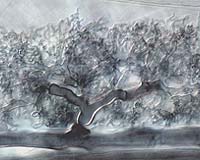
East Lansing MI (SPX) Jun 09, 2005 It seems a mighty feat for a microscopic fungus built from threadlike filaments. But collectively, these spindly mushroom relatives help move several billion tons of nutrients out of the soil and into plants each year. Now, new Michigan State University-supported research on the movement of nitrogen brings into sharper focus this underground process at the root of nearly all of Earth's food chains. "Ignorance (about the movement of nitrogen) limits our understanding... in what is arguably the world's most important symbiosis," says Yair Shachar-Hill, the lead MSU author on the study. The success of the Green Revolution to increase agricultural yields around the world has relied on the use of synthetic nitrogen fertilizers. The price of fertilizers is increasing, however, as are concerns about nitrogen runoff from large agricultural operations. Nitrogen also is a component of acid rain, which remains common in rapidly industrializing parts of the world, such as China. Eventually, an intricate knowledge of the nitrogen cycle might lead to more efficient use of fertilizers, more productive output on low-input and organic farming operations, and improved ability to stanch the effects of acid rain on natural ecosystems, Shachar-Hill says. "These exciting results suggest that fungi are more important in plant nitrogen nutrition than we have hitherto suspected," says Alastair H. Fitter, a plant biologist at the University of York and an expert in root system functioning. The fungus-plant partnership is one of the planet's oldest and dates back more than 400 million years, when plants began to move out of the oceans and onto land. Plants trade a bit of their sunlight-made sugars for building block nutrients that fungi wring from the soil. Scientists have understood broad outlines of this evolutionary bargain for years, but specific details remained fuzzy, especially those related to nitrogen. To learn more about nutrient uptake, MSU researchers led by Shachar-Hill, along with collaborators at New Mexico State University and the U.S. Department of Agriculture research center near Philadelphia, tagged nitrogen with easy-to-spot atomic markers and then watched as it traveled from soil to fungus to plant roots. Many had assumed that the fungus would play a modest role. The team found, however, that the fungus acts more like a four-lane highway than a two-track country road in shuttling the nitrogen into plant roots. More than a third of the total nitrogen taken up by the plants came by way of the fungus, Shachar-Hill and his collaborators report in the June 9 issue of Nature. "The really fascinating part is the mechanism underlying the transfer process," says Maria Harrison, a plant biologist at Cornell University's Boyce Thompson Institute and an expert on fungus-facilitated movement of other soil nutrients into plant roots. "Dr. Shachar-Hill and his colleagues were able to show that the fungus acquires the nitrogen from the soil and then links it to carbon and moves this combination molecule towards the plant. Then just before delivery to the plant cell, it unhitches the carbon and releases only the nitrogen to the plant." The researchers demonstrated the results in a highly controlled laboratory environment, so "the big challenge now will be to see whether the same mechanism is important for entire plants growing in symbiosis [partnership] with the fungi in soil, where other nitrogen sources may be more easily available," Fitter says. "Moving to the field is always difficult but rewarding." Community Email This Article Comment On This Article Related Links Shachar-Hill faculty Web page SpaceDaily Search SpaceDaily Subscribe To SpaceDaily Express Dirt, rocks and all the stuff we stand on firmly
 Magnetic Reconnection Region Larger Than 2.5 Million Km Found In The Solar Wind
 Paris (ESA) Jan 12, 2006
Using the ESA Cluster spacecraft and the NASA Wind and ACE satellites, a team of American and European scientists have discovered the largest jets of particles created between the Earth and the Sun by magnetic reconnection. This result makes the cover of this week's issue of Nature. |
|
|

| The content herein, unless otherwise known to be public domain, are Copyright 1995-2006 - SpaceDaily.AFP and UPI Wire Stories are copyright Agence France-Presse and United Press International. ESA PortalReports are copyright European Space Agency. All NASA sourced material is public domain. Additionalcopyrights may apply in whole or part to other bona fide parties. Advertising does not imply endorsement,agreement or approval of any opinions, statements or information provided by SpaceDaily on any Web page published or hosted by SpaceDaily. Privacy Statement |