|
 |
 |
 |
 |
 |
 |
 |
 |

 |
Dig Deeply To Seek Life On Mars
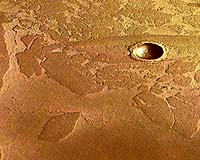
Washington DC (SPX) Jan 31, 2007 Probes seeking life on Mars must dig deeply into young craters, gullies, or recently exposed ice to have a chance of finding any living cells that were not annihilated by radiation, researchers report in a new study. One promising place to look for them is within the ice at Elysium, site of a recently discovered frozen sea, they say. Current probes designed to find life on Mars cannot drill deeply enough to find living cells that may exist well below the surface, according to the study. Although these drills may yet find signs that life once existed on Mars, the researchers say, cellular life could not survive incoming radiation within several meters [yards] of the surface. This puts any living cells beyond the reach of today's best drills. The study, to be published 30 January in the journal Geophysical Research Letters, maps cosmic radiation levels at various depths, taking into account surface conditions in various areas of Mars. The lead author, Lewis Dartnell of University College London, said: "Finding hints that life once existed--proteins, DNA fragments, or fossils--would be a major discovery in itself, but the Holy Grail for astrobiologists is finding a living cell that we can warm up, feed nutrients, and reawaken for studying." "Finding life on Mars depends on liquid water surfacing on Mars," Dartnell added, "but the last time liquid water was widespread on Mars was billions of years ago. Even the hardiest cells we know of could not possibly survive the cosmic radiation levels near the surface of Mars for that long." Unlike Earth, Mars is not protected by a global magnetic field or thick atmosphere, and for billions of years it has been open to radiation from space. The researchers developed a radiation dose model and quantified variations in solar and galactic radiation that penetrates the thin Martian atmosphere down to the surface and underground. They tested three surface soil scenarios and calculated particle energies and radiation doses both on the surface and at various depths underground, allowing them to estimate the survival times of any cells. The team found that the best places to look for living cells on Mars would be within the ice at Elysium, because the frozen sea is relatively recent--it is thought to have surfaced in the last five million years--and so has been exposed to radiation for a relatively short period of time. Even here, though, any surviving cells would be out of the reach of current drills. Other ideal sites include young craters, because the recently impacted surface has been exposed to less radiation, and gullies recently discovered in the sides of craters. Those channels may have flowed with water in the last five years and brought cells to the surface from deep underground. Title: "Modelling the surface and subsurface Martian radiation environment: Implications for astrobiology" :: Authors: Lewis Dartnell: Centre for Mathematics and Physics in the Life Sciences and Experimental Biology (CoMPLEX), University College London, London, United Kingdom; L. Desorgher: Physikalisches Institut, University of Bern, Bern, Switzerland; J. M. Ward: Department of Biochemistry and Molecular Biology, University College London, London, United Kingdom; A. J. Coates: Mullard Space Science Laboratory, University College London, Dorking, United Kingdom. :: Citation: Dartnell, L. R., L. Desorgher, J. M. Ward, and A. J. Coates (2007), Modelling the surface and subsurface Martian radiation environment: Implications for astrobiology, Geophys. Res. Lett., 34, L02207, doi:10.1029/2006GL027494. Community Email This Article Comment On This Article Related Links University College London Mars News and Information at MarsDaily.com Mars News and Information at MarsDaily.com Lunar Dreams and more
 Martian Clouds Pass By On A Winter Afternoon
 Pasadena CA (JPL) Jan 31, 2007
NASA's Mars Exploration Rover Opportunity captured a view of wispy afternoon clouds, not unlike fair weather clouds on Earth, passing overhead on the rover's 956th sol, or Martian day (Oct. 2, 2006). With Opportunity facing northeast, the clouds appear to drift gently toward the west in this movie taken with the rover's navigation camera. The 10 frames, taken 32 seconds apart, show the formation and evolution of what are likely mid-level, convective water clouds. |
|
|

| The content herein, unless otherwise known to be public domain, are Copyright 1995-2006 - SpaceDaily.AFP and UPI Wire Stories are copyright Agence France-Presse and United Press International. ESA PortalReports are copyright European Space Agency. All NASA sourced material is public domain. Additionalcopyrights may apply in whole or part to other bona fide parties. Advertising does not imply endorsement,agreement or approval of any opinions, statements or information provided by SpaceDaily on any Web page published or hosted by SpaceDaily. Privacy Statement |