|
 |
 |
 |
 |
 |
 |
 |
 |

 |
Difficult Beginnings: Europe, Quo Vadis?
Paris, France (ESA) Jun 01, 2005 Europe's successes in space are all the more remarkable in that they have been achieved against a background of diverging interests, with scientific, political and economic considerations on the one side, and the more nationally-focused thinking of the various European states on the other. In other words, forty years ago, Europe was still on a learning curve. This is especially apparent from the fact that there were originally two intergovernmental European space organisations: ESRO for the development and construction of science satellites, and ELDO for separate rocket launcher development. Paradoxically, the first successful satellite launch by ESRO on 17 May 1968 also triggered the first crisis within that organisation. At the heart of the controversy was the question whether applications satellites � chiefly for telecommunications and meteorology purposes - should be developed alongside research satellites, something which the ESRO Convention specifically excluded. It was not until four years later, in 1972, that the deadlock was broken. It was agreed that the organisation's science programme would remain a mandatory activity, to which each Member State (Belgium, Germany, Denmark, France, the United Kingdom, Italy, the Netherlands, Sweden, Switzerland and Spain) was to contribute, on the basis of GNP. But a new, optional programme was introduced covering the area of applications, in which the Member States could participate on a voluntary basis. However, problems were to arise not just at ESRO but also with ELDO. It set up Europe's first rocket range at Woomera in the South Australia desert and in 1964 began developing its own launcher, which was soon to be given the name Europa-1. After a succession of launch failures, it was decided to move the entire operation to Kourou in French Guiana. There, the conditions for launching satellites into geostationary orbit at altitudes of 36 000 km over the Equator were recognised as being considerably more advantageous. But even with a Europa-2 upgrade incorporating an additional solid-propellant stage, success for Europe remained elusive. The one launch carried out on 5 November 1971 was unsuccessful. In 1973, the project was scrapped, along with the already-ongoing programme studies on an improved Europa-3 version. This meant that ELDO did not ultimately achieve its own set objective of having a Europa rocket put a satellite into earth orbit.
1975 the turning point: establishment of the ESA Its mistrust of the space transport monopoly of the two superpowers was not unfounded. Contrary to initial US assurances, the go-ahead to use an American rocket to launch Europe's first geostationary communication satellites � the Franco-German Syphonie satellites � was forthcoming only after Europe had given its assurance that these systems were to be used exclusively for experimental purposes and not for operational commercial ends. On 31 July 1973, an extensive space package was put together by the meeting of ministers in Brussels which laid decisive foundations for a successful and future-oriented space programme. The spearhead of these ambitions was the development of the L3S. This launcher, eventually to be renamed Ariane, was destined to make a sensational impact and actually come to symbolise Europe's space endeavours. The development of the Ariane launcher continued under the auspices of the newly-established European Space Agency, which finally came into existence following the merging of ESRO and ELDO, officially starting work on 31 May 1975. There were ten founding Member States: Belgium, Germany, Denmark, France, the United Kingdom, Italy, the Netherlands, Sweden, Switzerland, Spain. In that same year, Ireland joined. Since then, Austria, Norway, Finland, Portugal and Greece have also become members. And with the imminent accession of Luxembourg at the end of 2005, the number of Member States is set to become 17. Canada works on several ESA programmes on the basis of a long-term Cooperation Agreement. Hungary and the Czech Republic have also recently started to cooperate with ESA.
Money invested flows back to ESA Member States Large-scale space technology programmes in the area of infrastructure are therefore one cornerstone of ESA activities, such as the development of successive generations of the Ariane launcher and the human spaceflight programme, which is due to deliver the European contribution to the International Space Station in the form of the Columbus laboratory and the supply flights using the unmanned Automated Transfer Vehicle (ATV). In addition, the Agency carries out various programmes in the fields of space science, microgravity research, space transport systems, remote sensing, telecommunications and navigation. All such programmes are organised and carried out by ESA as a European enterprise. Without these strategically key space programmes, we in the Europe of today would have to rely on outside help with telecommunications and resources management. ESA also plays a coordinating role, in that it monitors activities pursued by the Member States nationally and, where appropriate, integrates them within a European framework. Its tasks also include development further down the line of innovative space technologies in order to help Europe build up an internationally competitive space industry. ESA at thirty has at its disposal for 2005 a budget of �2977 million. The bulk of the money is spent on orders with industry in the various Member States. The allocation procedure stipulates that each Member State is to receive a fair financial and technological return on its investment.
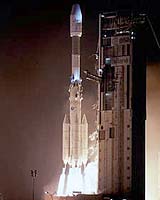
European launchers: a phoenix from the ashes For there was at that time no market for satellite launch services. On the contrary, the United States was winding up its fleet of rocket launchers in favour of developing the reusable Space Shuttle. This was supposed to slash launch costs, with launches of production-line satellites set to become a weekly occurrence. Faced with such an outlook, who would have banked on a conventional rocket launcher proving successful? When on Christmas Eve in 1979 the first Ariane was launched on its maiden flight and flawlessly reached its planned orbit, there was both joy and astonishment in equal measure: the Europeans could build a rocket launcher after all Ariane came to symbolise Europe and symbolise an open market. To handle Ariane launch service sales and marketing, a private operator - Arianespace - was set up, its shareholders being drawn from the European space industry. It soon became apparent however that the lift-capability of the original Ariane configuration was no longer sufficient to meet international market demand, for, despite miniaturisation, satellite size and mass were on the increase. ESA reacted promptly. In 1981, it embarked on a programme designed to improve the performance of the European launcher. The subsequently-developed Ariane versions 2 and 3 also provided the possibility of dual-payload launches for the first time in the history of conventional launcher design. Ariane 4 grew to become the undisputed star of a growing Ariane family and also one of the most reliable and economically successful launchers in the world. During its fifteen-year career from 1988 to 2003, it lifted over 180 satellites into orbit. Arianespace, exploiting its "dual-launch" market brand and "modular configuration", achieved a market share of up to 60% of commercial satellite launches worldwide. The continued technical and industrial success of the launcher sector in Europe now depends on the current Ariane 5 version. By 2001, ESA had decided that Ariane's payload lift-capability was to be upgraded from 7.5 to ten and eventually twelve tonnes. ESA is currently still researching various concepts for a programme geared to designing a successor to Ariane. It is still an open question as to whether this will involve developing a reusable or an expendable launch system.
Towards a coordinated European space effort ESA has built up the necessary structures on a joint European basis. Along with its Headquarters based in Paris are the following establishments and centres: ESTEC: the European Space Technology Centre, in Noordwijk (the Netherlands). Essentially, ESA's technical research and test facilities are to be found here. ESOC: the European Space Operations Centre, in Darmstadt (Germany), supported by an extensive network of advanced ground stations in Australia, Belgium, French Guiana, Italy, Sweden and Spain, controls satellite and probe operations. ESRIN: the European Space Research Institute, in Frascati near Rome (Italy), houses the Earth Observation Directorate and all related activities and is home to ESA's information services. EAC: the European Astronaut Centre, in Porz/Cologne (Germany). Since its founding in 1989, this has been the training centre for the European astronaut Corps. ESAC: the European Space Astronomy Centre, in Villafranca near Madrid, (Spain). This centre also handles the data archives of many ESA science missions. CSG: "Europe's Spaceport" in Kourou, French Guiana (South America), the launch and test-firing centre for European launchers (Ariane, Vega, Soyuz). The total number of staff at the European Space Agency, drawn from all the Member States, is currently around 1900 (in 2005). With ESA's programmes for launchers, science, telecommunications, Earth observation and human spaceflight, Europe has proved that it has expert competence in these areas. But these programmes are also important in terms of safeguarding and building up jobs for highly qualified specialists. At present, the European space industry directly employs 40 000 and indirectly 250 000. Community Email This Article Comment On This Article Related Links ESA SpaceDaily Search SpaceDaily Subscribe To SpaceDaily Express Space Tourism, Space Transport and Space Exploration News
 NASA Refines Design For Crew Exploration Vehicle
 Washington DC (SPX) Jan 12, 2006
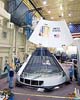
NASA's Constellation Program is making progress toward selecting a prime contractor to design, develop and build the Crew Exploration Vehicle (CEV), America's first new human spacecraft in 30 years. |
|
|

| The content herein, unless otherwise known to be public domain, are Copyright 1995-2006 - SpaceDaily.AFP and UPI Wire Stories are copyright Agence France-Presse and United Press International. ESA PortalReports are copyright European Space Agency. All NASA sourced material is public domain. Additionalcopyrights may apply in whole or part to other bona fide parties. Advertising does not imply endorsement,agreement or approval of any opinions, statements or information provided by SpaceDaily on any Web page published or hosted by SpaceDaily. Privacy Statement |