|
 |
 |
 |
 |
 |
 |
 |
 |

 |
Device Sorts Microscopic Particles With Speed And Precision
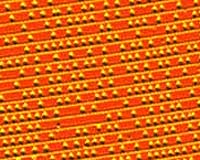
Princeton NJ (SPX) Jun 07, 2004 In a remarkable collaboration between engineers, physicists and biologists, Princeton scientists have invented a device that rapidly sorts microscopic particles into extremely fine gradations of sizes, opening a range of potential uses. The researchers have used the device to sort particles ranging in size from bacterial cells to large segments of DNA and reported their results in the May 14 issue of Science. The technology could greatly accelerate the work of sequencing genomes and could find uses in many other areas, from improving the performance of pharmaceuticals to detecting bioterrorism agents. Until now there was no way to sort large quantities of molecules or cells by size with such speed and precision, according to the researchers. Current methods separate particles only according to major differences in size and, for particles such as DNA, can take hours to perform. The Princeton invention can distinguish large quantities of particles that are 1.00 micrometer (a millionth of a meter) from others that are 1.005 microns in a matter of seconds. The device is dubbed a "tango array" for the precise choreography it imposes upon particles. The discovery was led by Lotien R. Huang, a postdoctoral researcher in electrical engineering, and grew out of a long-term collaboration between James Sturm, professor of electrical engineering, Robert Austin, a professor of physics, and Edward Cox, a professor of molecular biology, all of whom are co-authors of the Science paper. The group, which is part of the newly formed Princeton Institute for the Science and Technology of Materials, has produced a variety of devices for sorting DNA and other particles, but none as fast and precise as the tango array. The trade-off between speed and precision had seemed insurmountable, said Huang, who has been building and testing sorting devices for nearly six years. The breakthrough came when a collaborator in the physics department, former postdoctoral researcher Jonas Tegenfeldt, challenged Huang to come up with a mathematical description of how his earlier attempts at sorting devices worked: If he altered a device, could he predict exactly how its performance would change? "At first I thought such an analytical model would be impossible because the structures were so complicated, but Jonas got me thinking," said Huang, who has been working on the problem for six years. Within a few days, Huang not only derived a mathematical theory, but had an insight into making an entirely new device that has virtually no trade-off between speed and accuracy. Huang quickly made a prototype device and tested it with tiny plastic beads. "It gives such amazing separation resolution in just a minute," he said. "And the operation is very simple: You just need a syringe to push your sample through. We are very excited about it." The device consists of an array of microscopic pillars etched into silicon. Air from a syringe or other pump forces a liquid suspension of particles through the pillar array, which guides the particles into different paths. When the particles emerge from the array, they have been sorted into any number of "channels" according to size. A device less than 1 square inch could easily yield hundreds of channels, each just 1 percent different in size. The device works in a unique way because the arrangement of pillars forces particles along completely predetermined paths, like pennies and dimes rolling through a child's coin sorter. Previous attempts required the particles to diffuse randomly so that bigger particles slowly drifted one way and smaller ones another. Researchers had believed that fixed paths were not possible in part because small particles jiggle constantly, making them move in uncontrollable ways. Huang discovered that, with the proper arrangement of pillars, the particles could be made to slide in a tango-like dance forward or sideways at each obstacle depending precisely on the particle's size. "To suddenly say that there is a deterministic (non-random) way to do this really flies in the face of conventional wisdom," said Austin. "It's something I never would have thought of." The device could greatly speed up and expand many areas of biological research and could largely replace some centrifuge devices that are commonly used to separate cells and molecules based on mass, according to Cox. A primary use could be in sorting segments of DNA according to their length, which is a key step in genome sequencing efforts. Another use may be in distinguishing one type of virus from another, because many viruses have a unique size, slightly different from other viruses, Cox said. "Right now we use antibodies; we use microscopes; we sequence the genomes -- there are just a huge number of heavy-duty 20th century tricks," said Cox. "It may be that this device will let us say in an instant that we have one kind of virus and not another." In pharmaceuticals, the size of the drug particles in a capsule can play a critical role in how quickly the drug is absorbed and excreted in the body, noted Sturm. "You can use advanced chemical engineering methods to create particles of a certain size, but once you have done that there is not a lot you can do to filter out exact sizes and check the quality," Sturm said. Huang said the device could also result in improved ink jet printers, which produce better results if the ink particles are sized precisely. The researchers are now working to make a tango array for even smaller particles, including clusters of just a few protein molecules. It should only be a question of making a smaller array of silicon pillars, which is hard but not impossible, said Huang. "So long as you can make this pattern, you get the same performance," he said. Community Email This Article Comment On This Article Related Links Princeton University SpaceDaily Search SpaceDaily Subscribe To SpaceDaily Express Space Technology News - Applications and Research
 NGC Chosen To Proceed With Developing Solid-State Laser Technology For Military Applications
 Redondo Beach CA (SPX) Jan 09, 2006
Northrop Grumman Corporation has been selected to develop "military-grade," solid-state laser technology that is expected to pave the way for the U.S. military to incorporate high-energy laser systems across all services, including ships, manned and unmanned aircraft, and ground vehicles. |
|
|

| The content herein, unless otherwise known to be public domain, are Copyright 1995-2006 - SpaceDaily.AFP and UPI Wire Stories are copyright Agence France-Presse and United Press International. ESA PortalReports are copyright European Space Agency. All NASA sourced material is public domain. Additionalcopyrights may apply in whole or part to other bona fide parties. Advertising does not imply endorsement,agreement or approval of any opinions, statements or information provided by SpaceDaily on any Web page published or hosted by SpaceDaily. Privacy Statement |