|
 |
 |
 |
 |
 |
 |
 |
 |

 |
Deuteron-Gold Collisions Intensify Search For New Form Of Matter
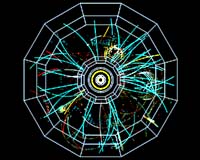
Upton - Jun 18, 2003 The latest results from the Relativistic Heavy Ion Collider (RHIC), the world's most powerful facility for nuclear physics research, strengthen scientists' confidence that RHIC collisions of gold ions have created unusual conditions and that they are on the right path to discover a form of matter called the quark-gluon plasma, believed to have existed in the first microseconds after the birth of the universe. The results will be presented at a special colloquium at the U.S. Department of Energy's Brookhaven National Laboratory on June 18 at 11 a.m., to coincide with the submission of scientific papers on the results to Physical Review Letters by three of RHIC's international collaborations. The scientists are not yet ready to claim the discovery of the quark-gluon plasma, however. That must await corroborating experiments, now under way at RHIC, that seek other signatures of quark-gluon plasma and explore alternative ideas for the kind of matter produced in these violent collisions. "This is a very exciting result that clearly indicates we are on the right track to an important scientific discovery," said Thomas Kirk, Brookhaven's Associate Laboratory Director for High Energy and Nuclear Physics. "But the case for having created quark-gluon plasma is not yet closed. We have four experiments looking for a number of different 'signatures' of this elusive form of extremely hot, dense nuclear matter." "These results from RHIC are profoundly important," said Raymond L. Orbach, Director of the Department of Energy's Office of Science, the primary funding agency for research at RHIC. "They go to a fundamental question in science: how did the universe look at the beginning of time? People have always been fascinated by the question of how our world began. And every time something fundamental is learned, society eventually benefits, either directly from that knowledge or from the technology developed to obtain it."
The Results These deuteron-gold experiments, along with other experiments using two colliding beams of protons, serve as a basis for comparison with collisions of two gold beams at RHIC. The gold-gold collisions, which bring nearly 400 protons and neutrons into collision at once, are designed to recreate, for a fleeting instant in the laboratory, the extremely hot, dense conditions of the early universe. When two gold nuclei collide head-on, the temperatures reached are so extreme (more than 300 million times the surface temperature of the sun) that the individual protons and neutrons inside the merged gold nuclei are expected to melt, releasing the quarks and gluons normally confined within them to form a tiny sample of particle "soup" called quark-gluon plasma. In contrast, the small deuteron passes through the large gold nucleus like a bullet, without heating or compressing it very much. The gold nucleus remains in its usual state, composed of distinct protons and neutrons. In either type of collision, a pair of energetic quarks can be knocked loose from within a proton or neutron. Each of these loose quarks will produce a "jet" of ordinary particles, and the two jets will emerge back-to-back from the collision region. Scientists can use these jets to probe nuclear environments. In the deuteron-gold experiments conducted this spring, back-to-back jets were seen to emerge, but in head-on collisions from the earlier gold-gold experiments, one of the two jets was missing. In addition, fewer highly energetic individual particles are observed coming from gold-gold than from deuteron-gold collisions. Scientists are intrigued by these distinctions, which clearly show that head-on gold-gold collisions are producing a nuclear environment quite different from that of deuteron-gold collisions. One possible explanation of the missing jets is that a quark traveling through this new environment would interact strongly and lose a substantial amount of its energy. Thus, if a quark pair is produced near the surface of the nuclear fireball resulting from a head-on collision of gold nuclei, the outward-bound quark is able to escape, while the inward-bound quark is absorbed. Only one jet is detected by the physicists. This phenomenon is called "jet quenching" and was predicted to occur in quark-gluon plasma. The same calculations also predicted the observed suppression of high-energy individual particles. If further scientific research proves that a quark-gluon plasma has been made, the physics story has just begun. By studying the behavior of free quarks and gluons in the plasma, RHIC scientists hope to learn more about the strong nuclear force -- the force that holds quarks together in protons and neutrons. Community Email This Article Comment On This Article Related Links Brookhaven On the Trail of Quark-Gluon Plasma Cooking Up Quark Soup SpaceDaily Search SpaceDaily Subscribe To SpaceDaily Express Nuclear Space Technology at Space-Travel.com
 JHU-STScI Team Maps Dark Matter In Startling Detail
 Baltimore MD (SPX) Dec 12, 2005
Clues revealed by the recently sharpened view of the Hubble Space Telescope have allowed astronomers to map the location of invisible "dark matter" in unprecedented detail in two very young galaxy clusters. |
|
|

| The content herein, unless otherwise known to be public domain, are Copyright 1995-2006 - SpaceDaily.AFP and UPI Wire Stories are copyright Agence France-Presse and United Press International. ESA PortalReports are copyright European Space Agency. All NASA sourced material is public domain. Additionalcopyrights may apply in whole or part to other bona fide parties. Advertising does not imply endorsement,agreement or approval of any opinions, statements or information provided by SpaceDaily on any Web page published or hosted by SpaceDaily. Privacy Statement |