
 |
 |
 |
 |
 |
 |
 |
 |
 |

 |
Detective Astronomers Unearth Hidden Celestial Gem
Paris, France (ESA) Jun 27, 2008 ESA's orbiting X-ray observatory XMM-Newton has re-discovered an ignored celestial gem. The object in question is one of the youngest and brightest supernova remnants in the Milky Way, the corpse of a star that exploded around 1000 years ago. Its shape, age and chemical composition will allow astronomers to better understand the violent ways in which stars end their lives. Exploding stars seed the Universe with heavy chemical elements necessary to build planets and create life. The expanding cloud of debris that each explosion leaves behind, known as a supernova remnant (SNR), is a bright source of X-rays and radio waves. Generally, the debris is thought to appear as an expanding bubble or ring. When astronomers took the first high-resolution radio images of a celestial object known as 'G350.1-0.3' in the 1980s, they saw an irregular knot of gases that did not seem to meet these expectations. So it was classified as a probable background galaxy and was quietly forgotten. Now Bryan Gaensler and Anant Tanna, both at the University of Sydney, have used the X-ray capabilities of XMM-Newton with their colleagues to prove that appearances can be deceptive. G350.1-0.3 is indeed the debris of an exploded star despite its misshapen configuration. In fact, it turns out to be one of the youngest and brightest supernova remnants in the Milky Way. To explain its shape, the team looked at radio surveys and discovered that G350.1-0.3 had exploded next to a dense cloud of gas about 15 000 light-years from Earth. The cloud prevented the blast from expanding evenly in all directions, resulting in an example of a rare kind of misshapen supernova remnant. G350.1-0.3 is incredibly small and young in astronomical terms, only eight light years across and about 1000 years old. "Only a handful of such young supernova remnants are known. So even having one more is important," says Tanna. That is because young supernova remnants are highly luminous, with the newly-formed chemical elements glowing brightly, making them easier to study. "We're seeing these heavy elements fresh out of the oven," says Gaensler. Young supernova remnants exhibit the newly created elements and also contain clues about the way the original star exploded. Such information is lost in most supernova remnants because, as they expand and age, they lose their initial characteristics. "After 20 000 years, all sorts of explosions look more or less the same," says Gaensler. Astronomers now recognise that stars explode in many different ways. Some might be just big enough for an explosion to occur, others might be much more massive. There are differences in the chemical composition of the exploding stars and some may have a companion star in orbit around them. Gaensler and Tanna hope that further investigations of G350.1-0.3 will yield clues as to exactly what kind of star exploded. "It may turn out that many of the youngest supernova remnants have these strange shapes," says Tanna, "The hunt to find more is now on." Despite the light from the supernova having reached Earth during the time of William the Conqueror, Gaensler thinks humans would not have seen it. "The X-ray data tell us that there's a lot of dust lying between it and Earth. Even if you'd been looking straight at it when it exploded, it would've been invisible to the naked eye," he says. Thankfully, XMM-Newton's sensitivity and the detective work by Gaensler and Tanna mean that this important celestial object will never again be forgotten. Community Email This Article Comment On This Article Share This Article With Planet Earth
Related Links the missing link Stellar Chemistry, The Universe And All Within It
 Catching The Light Of A Baby Supernova
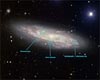 Hilo HI (SPX) May 26, 2008
Astronomers have observed the aftermath of spectacular stellar explosions known as supernovae before, but until now no one has witnessed a star dying in real time. While observing supernova 2007uy with the Swift X-ray Telescope, Alicia Soderberg and Edo Berger (Princeton University) discovered a mysterious X-ray flash elsewhere in the galaxy NGC 2770 located about 90 million light years away. |
|
|

| The content herein, unless otherwise known to be public domain, are Copyright 1995-2007 - SpaceDaily.AFP and UPI Wire Stories are copyright Agence France-Presse and United Press International. ESA Portal Reports are copyright European Space Agency. All NASA sourced material is public domain. Additional copyrights may apply in whole or part to other bona fide parties. Advertising does not imply endorsement,agreement or approval of any opinions, statements or information provided by SpaceDaily on any Web page published or hosted by SpaceDaily. Privacy Statement |
 del.icio.us
 Digg
Digg Reddit
 YahooMyWeb
 Google
 Facebook