|
 |
 |
 |
 |
 |
 |
 |
 |

 |
Designing An Ultrasensitive Optical Nose For Chemicals
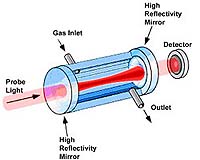
Denver CO (SPX) Nov 11, 2004 A laser-based method for identifying a single atom or molecule hidden among 10 trillion others soon may find its way from the laboratory to the real world. Developed by physicists at the National Institute of Standards and Technology (NIST), the technique is believed to be more than 1,000 times more sensitive than conventional methods. Vescent Photonics of Denver, Colo., hopes to commercialize the method as an "optical nose" for atmospheric monitoring. The portable sensors would rapidly identify chemicals in a gas sample based on the frequencies of light they absorb. Other applications eventually may include detection of chemical weapons and land mines, patient breath analysis for medical diagnosis or monitoring, and industrial detection of leaks in subterranean pipes or storage tanks, the company says. Vescent recently signed a Cooperative Research and Development Agreement with NIST. The company will work with NIST physicist Jun Ye (co-developer of the technology) to apply the public domain "optical nose" technique to detecting and quantifying trace quantities of atmospheric gases. Ye works at JILA, a joint institute of NIST and the University of Colorado at Boulder. The technique is a product of years of work and several innovations by NIST scientists. A gas sample is placed in an optical cavity containing two highly reflective mirrors. An infrared laser beam is directed into the cavity, where the light bounces back and forth many times. The repeated reflections increase the path length on which laser light will interact with gas molecules in the sample. In addition, the laser frequency is quickly and systematically varied in a way that enables scientists to observe and subtract background noise from the signal. The approach allows analysis of gases that are present in minute concentrations and at very low pressures, which may enable identification of compounds such as explosives that are difficult to detect by other means. Community Email This Article Comment On This Article Related Links Vescent Photonics NIST University of Colorado at Boulder SpaceDaily Search SpaceDaily Subscribe To SpaceDaily Express Space Technology News - Applications and Research
 LIGO Up And Running, But Gravity Waves Remain Elusive
 Washington DC (SPX) Jan 10, 2006
Scientists working on the Laser Interferometer Gravitational-Wave Observatory said Monday the facility has reached its target detection sensitivity, but the goal of finding the elusive phenomena known as gravity waves remains as elusive as ever. |
|
|

| The content herein, unless otherwise known to be public domain, are Copyright 1995-2006 - SpaceDaily.AFP and UPI Wire Stories are copyright Agence France-Presse and United Press International. ESA PortalReports are copyright European Space Agency. All NASA sourced material is public domain. Additionalcopyrights may apply in whole or part to other bona fide parties. Advertising does not imply endorsement,agreement or approval of any opinions, statements or information provided by SpaceDaily on any Web page published or hosted by SpaceDaily. Privacy Statement |