|
 |
 |
 |
 |
 |
 |
 |
 |

 |
Designing A Digital Toolbox To Quickly Check Cognitive Function
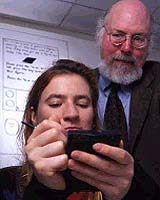
Houston - Apr 30, 2003 A new computer software package, currently under development, will give the term "personal digital assistant" (PDA) a new meaning, helping users quickly and easily evaluate if they are operating at their mental best. "Difficult tasks, such as an astronaut performing a space walk or a surgeon doing a complicated operation, require the utmost attention and vigilance. We're developing a way for people to test themselves and make sure they are mentally up to the challenge," said Dr. Stephen Kosslyn, a researcher on the National Space Biomedical Research Institute's (NSBRI) neurobehavioral and psychosocial factors team. "Test results can help users determine if they need to eat, sleep, exercise, or better focus their thoughts on the task at hand." MiniCog, a new software package being developed and tested by Kosslyn's research team, could help people in many situations determine what they are capable of safely achieving. The program is quick, easy to use, and designed for use on the newest-generation PDA. MiniCog contains nine cognitive tasks that evaluate attention, working memory, problem-solving ability, motor control and ability to switch thinking among cognitive sets. The battery of tasks does not have to be taken all at once, but rather a subset of tests can be used to assess certain aspects of the user's mental ability at a given time. "Each task takes about two minutes to complete," Kosslyn said. "Once you've taken the tests a couple of times, you won't need to read the instructions anymore, and the tasks are easier to complete without affecting the outcome of the test," Kosslyn said. "It's more like a game." The program keeps users' scores, so they can see how they are performing relative to past tests. A graph comes up at the end that shows the results. The package is designed for astronauts who often have sleep disruption while in flight or experience other side effects from being in a weightless environment, but it will be applicable to other industries or people in extreme environments. For example, surgeons could utilize the tests before beginning a lengthy procedure, or long-distance truck drivers could determine when they need a nap. "The tasks used in MiniCog are based on validated paradigms and documented cognitive performance tests, but the stimuli for the tasks are new to this package and the duration of the tasks varies from standard tests," said Jennifer Shephard, research assistant on the project. The well-documented Stroop Test, used for decades as an evaluator for attention, is one of the tasks. With MiniCog, the word "red" appears on the PDA screen, but the color of the word can be blue. A user is asked to quickly respond with the color of the ink. Another test, the "odd-man-out," asks users to identify a lower-case letter in a series of upper-case characters. At some point the test switches, and users are asked to choose an odd letter in a series rather than the case. MiniCog measures how much time it takes the user to make the switch and the errors the user makes. While undergoing pilot testing, user feedback and data were analyzed to refine the timing of the tasks. Now, Kosslyn's group is gathering comparative information among users and validating the tasks against traditional cognitive tests. Future tests will include using the program on test subjects who are working in extreme environments. "Once we have a final program with user averages that model what normal variability is under different, stressful environments, we can provide people with enough information so they'll take the proper precautions," Shephard said. "That's why we designed MiniCog. We want users to know how they're doing, so they can take care in future behavior whether it's driving another shift or doing a space walk." Community Email This Article Comment On This Article Related Links National Space Biomedical Research Institute SpaceDaily Search SpaceDaily Subscribe To SpaceDaily Express Space Station News at Space-Travel.Com
 NASA Had No Choice But To Buy Soyuz Flights
 Washington DC (SPX) Jan 09, 2006
NASA's announcement last week that it will pay Roskosmos $43.6 million for a round-trip ride to the International Space Station this spring, and an equivalent figure for an as-yet-undetermined number of future flights to the station until 2012, represents the agency's acknowledgment that it had no alternative. |
|
|

| The content herein, unless otherwise known to be public domain, are Copyright 1995-2006 - SpaceDaily.AFP and UPI Wire Stories are copyright Agence France-Presse and United Press International. ESA PortalReports are copyright European Space Agency. All NASA sourced material is public domain. Additionalcopyrights may apply in whole or part to other bona fide parties. Advertising does not imply endorsement,agreement or approval of any opinions, statements or information provided by SpaceDaily on any Web page published or hosted by SpaceDaily. Privacy Statement |