|
 |
 |
 |
 |
 |
 |
 |
 |

 |
Delft Water-Purification Method Promises Radical Improvement
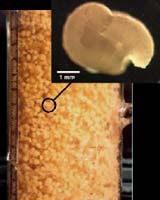
Delft, Holland (SPX) Jun 25, 2006 Delft University of Technology research has discovered a method that could drastically change the way we purify water within a few years. Delft, in partnership with DHV engineering bureau, has developed a compact and environmentally-friendly purification method, in which aerobic bacteria form granules that sink quickly. An important part of the project's success was the work of Delft researcher Merle de Kreuk, who, on Tuesday, 27 June, will receive her PhD degree based on this research subject. With the new aerobic granular sludge technology (Nereda TM), aerobic (thus oxygen using) bacterial granules are formed in the water that is to be purified. The great advantage of these granules is that they sink quickly and that all the required biological purifying processes occur within these granules. The technology therefore offers important advantages when compared to conventional water purification processes. For example, all the processes can occur in one reactor. Moreover, there is no need to use large re-sinking tanks, such as those used for conventional purification. Such large tanks are needed for this because the bacteria clusters that are formed take much longer to sink than the aerobic granule sludge. According to Delft PhD researcher Merle de Kreuk, a Nereda TM purification installation needs only a quarter of the space required by conventional installations. Moreover, Nereda TM uses 30% less energy than the normal purification process. This Nereda TM purification process is suitable for both domestic and industrial waste water. Delft University of Technology has a long tradition in researching the possibilities of water purification with aerobic granular sludge. The maturation of the technology is largely due to the research conducted by De Kreuk. During her PhD research with Prof. Mark van Loosdrecht, De Kreuk - working together with DHV engineering bureau and supported by STOWA and STW grants - solved various technological bottlenecks and expanded the capacity of the test installation from 3 litres per hour to 1,500 litres per hour. DHV now has the final design, which is ready for practical implementation. The aerobic granular sludge technology is very promising, and has been nominated for the Dutch Process Innovation Award 2006. The technology is now in the commercialisation phase. In the coming years, De Kreuk will continue to contribute to the project's trajectory as a Delft researcher. DHV is currently negotiating with water purification companies to test this purification method on a larger scale. The first installations are already in use in the industrial sector. Community Email This Article Comment On This Article Related Links Delft University of Technology Water News - Science, Technology and Politics
 Creating A Window On Oceans In Motion
 Halifax, Canada (SPX) Jun 25, 2006
Scientists and resource managers could soon have a highly detailed picture of marine conditions and the migrations of fish and ocean animals throughout the world, according to international experts convening a landmark conference in Canada June 27-30. |
|
|

| The content herein, unless otherwise known to be public domain, are Copyright 1995-2006 - SpaceDaily.AFP and UPI Wire Stories are copyright Agence France-Presse and United Press International. ESA PortalReports are copyright European Space Agency. All NASA sourced material is public domain. Additionalcopyrights may apply in whole or part to other bona fide parties. Advertising does not imply endorsement,agreement or approval of any opinions, statements or information provided by SpaceDaily on any Web page published or hosted by SpaceDaily. Privacy Statement |