|
 |
 |
 |
 |
 |
 |
 |
 |

 |
Defense Weather Bird Ready For Launch
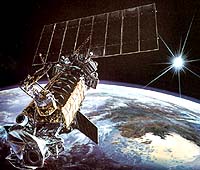
Vandenberg - Jan. 15, 2001 A Defense Meteorological Satellite Program (DMSP) Block 5D-3 spacecraft, built under contract for the U.S. Air Force by Lockheed Martin Space Systems Company, Sunnyvale, Calif., is being prepared for launch on January 19, 2001. A Titan II launch vehicle, supplied by Lockheed Martin Space Systems Company in Denver, will carry the weather satellite into orbit from Vandenberg Air Force Base, Calif. "We're very pleased to have our second Block 5D-3 spacecraft out at the launch pad," said Al Lauer, Lockheed Martin director of Weather Satellite Programs. "Our partnership with the Air Force goes back to the very beginning of the DMSP program with a common goal of ensuring that commanders have access to environmental data critical to the preparation and execution of military operations." The Block 5D-3 series accommodates larger sensor payloads than earlier generations. They also feature a larger capability power subsystem; a more powerful on-board computer with increased memory -- allowing greater spacecraft autonomy -- and increased battery capacity that extends the mean mission duration. Within two hours of launch, the DMSP Early-Orbit Team at the National Oceanic and Atmospheric Administration (NOAA) Space Operations Control Center (SOCC) in Suitland, Md. will begin checkout of the spacecraft. The procedures are scheduled to take about thirteen days. An instrument checkout will follow, taking an additional two weeks. When the spacecraft is declared operational, the satellite will be turned over to the National Polar Orbiting Environmental Satellite System (NPOESS) Integrated Program Office (IPO). The IPO Assistant Director of Operations (ADO) will then officially delegate operational responsibility to the NOAA Office of Satellite Operations. DMSP, operated by NOAA, is used for strategic and tactical weather prediction to aid the U.S. military in planning operations at sea, on land and in the air. Equipped with a sophisticated sensor suite that can image visible and infrared cloud cover, the satellite collects specialized meteorological, oceanographic, and solar-geophysical information in all weather conditions. The DMSP constellation comprises two spacecraft in near-polar orbits, C3 (command, control and communications), user terminals and weather centers. The most recent launch of a DMSP spacecraft took place on December 12, 1999 from Vandenberg Air Force Base. That launch marked the first of the Block 5D-3 satellites. Currently, a reserve of four satellites is maintained at Space Systems' operations in Sunnyvale, Calif. for storage, functional testing, and upgrading. The Titan launch vehicle is produced by Space Systems operations in Denver, Colo. The spacecraft are shipped to Vandenberg for launch when requested by the Air Force. Since 1966, more than 30 Lockheed Martin DMSP satellites have been launched by the U.S. Air Force. Now in its fourth decade of service, the DMSP has proven itself to be a valuable tool in scheduling and protecting military operations on land, at sea and in the air. Community Email This Article Comment On This Article Related Links DMSP-5D at FAS Lockheed Martin Space Systems SpaceDaily Search SpaceDaily Subscribe To SpaceDaily Express Military Space News at SpaceWar.com
 GD Completes First Conversion Of Subs For US Navy Transformational Program
 Bremerton WA (SPX) Jan 10, 2006
General Dynamics Electric Boat has completed its conversion of USS Ohio (SSGN-726), the first of four Trident submarines to be reconfigured as multimission vessels optimized for covert tactical strike and special operations support. Electric Boat is a wholly owned subsidiary of General Dynamics. |
|
|

|
|
|
|
|
|
|
|
|
|
|
|
| The content herein, unless otherwise known to be public domain, are Copyright 1995-2006 - SpaceDaily.AFP and UPI Wire Stories are copyright Agence France-Presse and United Press International. ESA PortalReports are copyright European Space Agency. All NASA sourced material is public domain. Additionalcopyrights may apply in whole or part to other bona fide parties. Advertising does not imply endorsement,agreement or approval of any opinions, statements or information provided by SpaceDaily on any Web page published or hosted by SpaceDaily. Privacy Statement |