
 |
 |
 |
 |
 |
 |
 |
 |
 |

 |
Defense Focus: High-tech limits -- Part 3
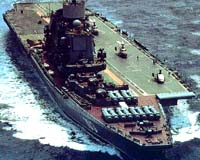
Washington (UPI) May 7, 2008 The United States, Russia, China, France and Britain have all found that pushing their high-tech capabilities too far has sometimes given them weapons systems that are turkeys instead of eagles. Because the U.S. defense industry sector is the largest and most technically advanced in the world, we focused far more on both its successes and failures than on those of other nations. But in recent decades, other major nations' defense establishments have often come to grief by trying to match U.S. defense capabilities. The field of producing large aircraft carriers is a case in point. Aircraft carriers have been around since World War I when the British pioneered the technology, but only a handful of nations have ever mastered the complex series of interacting maritime and aircraft engineering technologies capable of producing carrier forces that operated well. In World War II, only Britain, Japan and the United States ever mastered carrier operations, and British carriers until late in the war lagged far behind the U.S. and Imperial Japanese navies in their size and in the number of modern fast performance aircraft they could carry and operate. In recent decades, no nation has come close to matching the capabilities of the dozen or so carrier battle groups regularly operated by the U.S. Navy. The British have retained their mastery of small, or light, carrier operations, as they most recently showed in the 1982 Falklands War in the South Atlantic. But the French aircraft carrier Clemenceau proved to be extraordinarily ineffective in any operational capacity. It exhibited a remarkable number of engineering failings. Somewhat surprisingly, given the scale of the Soviet navy's shipbuilding capabilities over much of the Cold War, Russia too has stumbled badly in its ambitious aircraft carrier program. The Admiral Kuznetsov nearly sank when it went to sea a few years ago and had to ignominiously return to port as quickly as possible. More recently, the ambitious renovation of another old Soviet-era Russian aircraft carrier, the Admiral Gorshkov, for the Indian navy, ran far over budget and behind schedule after hitting one problem after another. The problems cost the director general of Sevmash his job and forced Russia to renegotiate the terms of the renovation with New Delhi. Russia has also come to grief in its ambitious GLONASS program that was meant to produce its own, independent answer to the U.S. global positioning system constellation of orbiting satellites. Here too, a nation's high-tech defense contractors and political leadership pushed ahead with an ambitious program that was way beyond its nation's technical capabilities to deliver. The $3 billion fiasco surrounding Britain's Nimrod early warning air defense system, supposed to be a national independent answer to the venerable and extremely reliable U.S. AWACS system, is another case in point. Most of these fiascoes came from other nations attempted to duplicate U.S. high-tech naval or military capabilities when they did not have the resources to do it. By contrast, as we have repeatedly documented in previous columns, America's own multibillion-dollar defense development fiascoes like the Clinton administration's Future Intelligence Architecture ISR satellite program or the Bush administration's gung-ho enthusiasm for the integrated Future Combat Systems strategy comes from taking current, very successful high-tech systems for granted and assuming -- wrongly -- that they can be extrapolated or magnified in their effectiveness to an infinite degree. But in the world of defense procurement, usually it is much wiser to simply appreciate what you've got and go on developing it incrementally. Community Email This Article Comment On This Article Share This Article With Planet Earth
Related Links The latest in Military Technology for the 21st century at SpaceWar.com
 US Army, Navy And Air Force Gain New Intelligence And Surveillance Capability
 Marietta GA (SPX) May 07, 2008
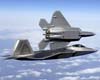
Two Lockheed Martin F-22 Raptors successfully sent classified sensor data to ground stations in the U.S. Air Force's Joint Expeditionary Force Experiment 2008 (JEFX 08) conducted April 15-25 at Nellis Air Force Base, Nev. JEFX is an Air Force Chief of Staff-sponsored experiment that combines real-world air and ground forces, simulation, and technology insertions into a warfighting environment. |
|
|

| The content herein, unless otherwise known to be public domain, are Copyright 1995-2007 - SpaceDaily.AFP and UPI Wire Stories are copyright Agence France-Presse and United Press International. ESA Portal Reports are copyright European Space Agency. All NASA sourced material is public domain. Additional copyrights may apply in whole or part to other bona fide parties. Advertising does not imply endorsement,agreement or approval of any opinions, statements or information provided by SpaceDaily on any Web page published or hosted by SpaceDaily. Privacy Statement |
 del.icio.us
 Digg
Digg Reddit
 YahooMyWeb
 Google
 Facebook