|
 |
 |
 |
 |
 |
 |
 |
 |

 |
Defense Focus: FCS follies -- Part 1
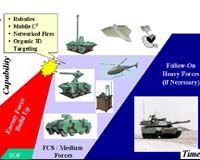
Washington (UPI) Jan 28, 2008 Are the cyber-pigeons coming home to roost? For the past 2-1/2 years, we have been reporting in these columns about the growing problems generating by former Defense Secretary Donald Rumsfeld's visionary Future Combat Systems program to make the U.S. armed forces unbeatable in the 21st century. FCS had the ambitious vision of integrating the firepower of combat forces of the U.S. Army through a wireless network in real time. It offered the prospect of field commanders video conferencing with front-line officers in tanks on the battlefield. It offered the vision of minimizing combat casualties by sending in large numbers of robots to defuse mines and open ways through battlefields. The program was one of the most costly in the history of the U.S. Army. The Washington Post Friday said its estimated cost was $200 billion. As we have previously reported in these columns, some estimates from the Congressional Budget Office and the Government Accountability Office have already gone 50 percent higher than that. And even those estimates assumed that the basic concepts of the program were sound and that it would work as projected. In fact, as the Post reported Friday, the number of lines of software code required by the project has more than doubled in only the past five years. The Army originally reckoned it needed 33.7 million lines of code. Now it reckons it needs 63.8 million. The paper also cited Dennis Muilenberg, Boeing's project manager on the FCS, as maintaining that the original estimate was 55 million lines of software, not 33 million. No one doubts that interconnectivity and rapid response is vital on the battle field. No one doubts the U.S. armed forces have enjoyed a decisive global superiority in applying these key technologies over the past quarter century. And no one with any sense doubts that it should be a top priority goal to seek to retain that advantage through the coming decades. But as we have warned in these columns before, the FCS from the very beginning appeared doomed to failure: It sought to replace the flexibility easily available in modern off-the-shelf communications technology with enormously ambitious and rigid integrated goals that swallowed up limitless resources. Yet, as we reported 2-1/2 years ago, three-star Army generals were cautiously warning back in August 2005 that the very concept of the FCS leaves it dangerously vulnerable to cyber-attack -- a form of asymmetrical warfare that China in particular has given top priority to, and that is also being developed energetically by Russia and India. These concerns have since become more widespread. The Post report cited a warning from the Defense Science Board, which advises the Office of the Secretary of Defense, as saying last year, "Malicious code is a key concern of the FCS program (and it) lacks confidence in current tools for detecting malicious code." In other words, the key strategic conception for continuing U.S. battlefield superiority for at least 20 years to come depends on an integrated software system that is still being developed, and that is certain to be vulnerable to hostile cyber-attacks even when it is finally completed. But that is only the first of the strategic and conceptual problems that the FCS mega-project faces. There are even more fundamental ones.
Email This Article Comment On This Article Related Links The latest in Military Technology for the 21st century at SpaceWar.com
 DRS Tech Gets Contract To Supply Marine Corps With Rugged Tablet Computers
 Parsippany NJ (SPX) Jul 10, 2007
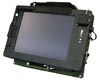
DRS Technologies has received a $5 million award as part of a previous contract to provide military rugged tablet (MRT) computers and peripheral equipment for the U.S. Marine Corps' Target Location Designation Handoff System (TLDHS) program. DRS received the order from Stauder Technologies in St. Peters, Missouri. For this contract the company's DRS Tactical Systems business unit in Melbourne, Florida, will produce hundreds of the handheld MRT computers and peripheral equipment. |
|
|

| The content herein, unless otherwise known to be public domain, are Copyright 1995-2007 - SpaceDaily.AFP and UPI Wire Stories are copyright Agence France-Presse and United Press International. ESA Portal Reports are copyright European Space Agency. All NASA sourced material is public domain. Additional copyrights may apply in whole or part to other bona fide parties. Advertising does not imply endorsement,agreement or approval of any opinions, statements or information provided by SpaceDaily on any Web page published or hosted by SpaceDaily. Privacy Statement |