|
 |
 |
 |
 |
 |
 |
 |
 |

 |
Defeating The 'Superpests'
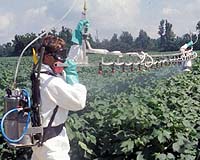
Sydney, Australia (SPX) Oct 07, 2005 Scientists have developed a new technique that makes pesticides more effective by removing insects' ability to exhibit resistance. Their research will extend the effective life of current pesticides, significantly reduce the amount that needs to be sprayed and remove the need for farmers to move to stronger and more harmful chemicals. Researchers at Rothamsted Research in Hertfordshire, working with researchers in New South Wales, Australia have developed a way to counter the pests' most common way of becoming resistant and in trials it has proved to be almost 100 per cent effective. Resistance to pesticides is a global problem, which is hitting tropical and developing countries particularly hard. Insect pests often develop resistance by over-producing enzymes that degrade the effectiveness of a pesticide. The Rothamsted scientists, supported by the Biotechnology and Biological Sciences Research Council (BBSRC), have developed a product that blocks the enzymes and then delivers a dose of pesticide 4-5 hours later to kill the newly defenceless insect. The technique uses piperonyl butoxide (PBO), a chemical derived originally from the sassafras tree and used for many years in laboratories to enhance the effectiveness of other chemicals. The PBO binds to the enzyme that would otherwise break down the pesticide. However, the key with this research has been to work out the correct time delay between applying the PBO inhibitor and spraying the pesticide. The insects' enzyme function has to be completely debilitated before pesticide is sprayed for the method to be effective. Dr Graham Moores, research leader at Rothamsted Research, said, "Populations of aphids, cotton bollworm, whitefly, diamondback moth and mosquitoes are all becoming harder to control so we need a way to overcome insects' increasing resistance to pesticides. "Using this approach to defeat the pests' enzyme processes reduces the amount of pesticide that farmers need to spray on a field. It will also help farmers in developing countries who cannot afford more costly, newer chemicals. In tests on whiteflies in Spain and Australia the enzyme inhibitor combined with a time delayed release of the pesticide proved to be almost 100 per cent effective." Professor Julia Goodfellow, Chief Executive of BBSRC, said, "This research shows how UK agricultural science can have real benefits for a wide range of people. This research has led to a product that can help both western and developing world farmers to defeat insects that have built up resistance to common pesticides. This will directly help to reduce the pesticide burden on the environment." The phased-release technology has been developed in partnership with Dr Robin Gunning at New South Wales Department of Primary Industries, Tamworth, Australia and the Italian company Endura SpA. Community Email This Article Comment On This Article Related Links Rothamsted Research SpaceDaily Search SpaceDaily Subscribe To SpaceDaily Express Farming Today - Suppliers and Technology
 Growing More Good Oil From The Sea
 Canberra, Australia (SPX) Dec 18, 2005
Oil-rich marine microalgae are being assessed for their commercial potential under a new agreement between Clover, the CSIRO Food Futures Flagship, and the CRC for Bioproducts. |
|
|

| The content herein, unless otherwise known to be public domain, are Copyright 1995-2006 - SpaceDaily.AFP and UPI Wire Stories are copyright Agence France-Presse and United Press International. ESA PortalReports are copyright European Space Agency. All NASA sourced material is public domain. Additionalcopyrights may apply in whole or part to other bona fide parties. Advertising does not imply endorsement,agreement or approval of any opinions, statements or information provided by SpaceDaily on any Web page published or hosted by SpaceDaily. Privacy Statement |