|
 |
 |
 |
 |
 |
 |
 |
 |

 |
Deep Impact Spacecraft and Impactor Begin Environmental Testing
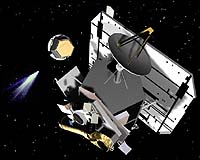
Boulder CO - Mar 31, 2004 The spacecraft pair that will give scientists their first up-close look at a comet entered the final testing phase before their launch scheduled for December 2004. The Flyby and Impactor spacecrafts for the Deep Impact mission will be joined in their final flight configuration to undergo thermal vacuum, vibration and acoustic testing. Despite this extensive on-earth testing, the Impactor spacecraft was designed to be vaporized upon impact with its target, the comet, Tempel 1. Both comet and spacecraft will be traveling at closing speeds of approximately 23,000 miles per hour upon impact. During the Deep Impact mission, the Flyby spacecraft will release a smaller Impactor spacecraft that will collide with Tempel 1. Deep Impact's telescopes aboard the Flyby spacecraft will witness the impact and return data to Earth regarding the composition of the comet based on the ejecta created from the collision. The collision with the Impactor spacecraft will form a crater in the comet, about the size of a football stadium, and as deep as 14-stories. The collision is expected to occur on July 4, 2005. The instruments onboard the Flyby spacecraft will return data on the pristine material in the crater and the material ejected by the impact. The High Resolution Imager aboard the Flyby spacecraft will be one of the largest interplanetary telescopes ever flown in order to record the details of the collision. The Impactor spacecraft will also provide close-encounter photos of the comet just prior to impact, giving scientists the most complete view of a comet to date. Community Email This Article Comment On This Article Related Links Deep Impact at JPL Deep Impact at University of Maryland Deep Impact at Bell Aerospace SpaceDaily Search SpaceDaily Subscribe To SpaceDaily Express Asteroid and Comet Mission News, Science and Technology
 NASA'S Spitzer Finds Possible Comet Dust Around Dead Star
 Pasadena CA (SPX) Jan 12, 2006
NASA's Spitzer Space Telescope has spotted what may be comet dust sprinkled around the white dwarf star G29-38, which died approximately 500 million years ago. |
|
|

| The content herein, unless otherwise known to be public domain, are Copyright 1995-2006 - SpaceDaily.AFP and UPI Wire Stories are copyright Agence France-Presse and United Press International. ESA PortalReports are copyright European Space Agency. All NASA sourced material is public domain. Additionalcopyrights may apply in whole or part to other bona fide parties. Advertising does not imply endorsement,agreement or approval of any opinions, statements or information provided by SpaceDaily on any Web page published or hosted by SpaceDaily. Privacy Statement |