|
 |
 |
 |
 |
 |
 |
 |
 |

 |
Deep Impact Mission Could Help Earth's Defence Against Space Rocks
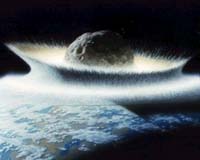
Paris (AFP) Jun 30, 2005 An extraordinary US mission to whack a passing comet may indirectly provide a windfall for guardians monitoring any space rocks that could hit Earth. The NASA probe Deep Impact is to eject a 372-kilo (820-pound) projectile that on Monday is scheduled to smack into Comet Tempel 1 as the heavenly wanderer flies past Earth at a great distance. The collision, occurring at 37,100 kph (23,000 mph, 6.3 miles per second) could gouge a crater as big as a football stadium and spew out a mass of cometary gas and dust, eagerly recorded by telescopes, radars and spectrometers. The goal behind the 333-million-dollar (275-million-euro) mission is to uncover the inner secrets of one of the Solar System's strangest phenomena. Comets are believed to comprise primitive material created in the early Solar System and, say some experts, may hold organic molecules that may have been the chemical building blocks for creating life on Earth. But comets can also be bringers of death, too. The long reign of the dinosaurs is believed to have been snuffed out some 65 million years ago when a comet smashed into modern-day Mexico, kicking up a pall of dust that obscured the Sun and chilled the climate. Scientists involved in Near Earth Objects (NEOs) -- comets and asteroids that may pose a threat to our home -- say Deep Impact could yield precious data. "The more we know the better, and there might be some surprises in this mission," David Harris, chairman of a NEO advisory panel set up by the European Space Agency (ESA), told AFP. "We might learn some something crucial about the structure of comets that could help us in the event that we faced something like this." The risks posed by NEOs must be put into context, for the probability of any collision is extremely remote. A stepped-up US-led effort to scour the skies for this threat has not yielded any prospect of a hit, although several rocks could make near-misses in coming decades. But any collision would carry astronomical costs. Smaller objects measuring two or three hundred metres (yards) across could devastate a region or trigger a tsunami, while larger ones could be climate-crushers. In this respect, "Deep Impact", the 1998 sci-fi movie about a doomsday comet, was not wrong, and the threat from NEOs is gaining credibility among politicians. Only a fraction of potentially risky asteroids -- the rocks that circle the Sun between Mars and Jupiter and which can sometimes be jostled into a different orbit -- has been identified and their orbits mapped. And nothing is known about types of comets, mercifully rare, that take centuries to orbit the Sun. Never spotted before, these could hurtle out of almost nowhere, giving mankind very little time to react. As to what that response should be, two main options present themselves: to send a space tug to gently deflect the rock to a different trajectory or to blow the brute up, Hollywood-style. Both are dependent on knowledge about the density and structure of the comet or asteroid -- and this is where Deep Impact comes in. "We don't really know whether most asteroids are mostly solid, riddled with cracks or voids, or made up of lots of loose rubble," the British magazine New Scientist said last week, a comment that also applies to comets, which are likened to "dirty snowballs" and are usually bigger than asteroids. "Any attempt to push one out of the way, whether with rocket blasts or bombs, might shatter it instead and just lead to even more impacts." Former Apollo astronaut Rusty Schweickart last month lobbied the US Congress to consider funding a scouting mission or even a deflection mission to 2004 MN4, a 320-metre (1,000-feet) asteroid that raised an alarm last December. Initial calculations suggested a risk that 2004 MN4 could strike Earth on April 13 2029, but this was downgraded to an extremely close shave -- a miss by about 36,000 kms (22,600 miles), which is inside the orbits of some geostationary satellites. But the tug effect of Earth's gravity during this fly-by means that 2004 MN4's orbit may be slightly altered, and an impact seven years later in 2036 cannot be ruled out. Community Email This Article Comment On This Article Related Links SpaceDaily Search SpaceDaily Subscribe To SpaceDaily Express Asteroid and Comet Impact Danger To Earth - News and Science
 NASA's Deep Impact Adds Color To Unfolding Comet Picture
 College Park MD (SPX) Sep 07, 2005
Painting by the numbers is a good description of how scientists create pictures of everything from atoms in our bodies to asteroids and comets in our solar system. Researchers involved in NASA's Deep Impact mission have been doing this kind of work since the mission's July 4th collision with comet Tempel 1. |
|
|

| The content herein, unless otherwise known to be public domain, are Copyright 1995-2006 - SpaceDaily.AFP and UPI Wire Stories are copyright Agence France-Presse and United Press International. ESA PortalReports are copyright European Space Agency. All NASA sourced material is public domain. Additionalcopyrights may apply in whole or part to other bona fide parties. Advertising does not imply endorsement,agreement or approval of any opinions, statements or information provided by SpaceDaily on any Web page published or hosted by SpaceDaily. Privacy Statement |