|
 |
 |
 |
 |
 |
 |
 |
 |

 |
Deep-Rooted Plants Have Great Impact On Climate
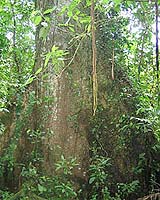
Berkeley CA (SPX) Jan 11, 2006 Trees, particularly those with deep roots, contribute to the Earth's climate much more than scientists thought, according to a new study by biologists and climatologists from the University of California, Berkeley. While scientists studying global climate change recognize the importance of vegetation in removing carbon dioxide from the atmosphere and in local cooling through transpiration, they have assumed a simple model of plants sucking water out of the soil and spewing water vapor into the atmosphere. The new study in the Amazonian forest shows that trees use water in a much more complex way: The tap roots transfer rainwater from the surface to reservoirs deep underground and redistribute water upwards after the rains to keep the top layers moist, thereby accentuating both carbon uptake and localized atmospheric cooling during dry periods. The researchers estimate this effect increases photosynthesis and the evaporation of water from plants, called transpiration, by 40 percent in the dry season, when photosynthesis otherwise would be limited. "This shifting of water by roots has a physiological effect on the plants, letting them pull more carbon dioxide from the atmosphere as they conduct more photosynthesis," said co-author Todd Dawson, professor of integrative biology at UC Berkeley. "Because this has not been considered until now, people have likely underestimated the amount of carbon taken up by the Amazon and underestimated the impact of Amazonian deforestation on climate." As the largest forested area on the planet, the Amazon plays a major role in removing carbon dioxide from the atmosphere and thus impacts the climate globally, according to lead author Jung-Eun Lee, a former UC Berkeley graduate student and now a post-doctoral fellow here. Dawson, Lee and their colleagues, including Inez Fung of UC Berkeley, reported their findings last month in the Dec. 6 issue of the Proceedings of the National Academy of Sciences. Fung is director of the Berkeley Atmospheric Sciences Center, co-director of the new Berkeley Institute of the Environment, and professor of earth and planetary science and of environmental science, policy and management. The researchers incorporated these new details into the most widely accepted model of global climate, and found that it accounts for a previously observed but unexplained dip in Amazonian temperature during the dry season. "Evapotranspiration stays higher than previously expected during the prolonged dry season because of this private reserve of water banked during the wet season by the tap roots," said Dawson. "Just as perspiration cools us off, increased transpiration by trees in June and July explains the drop in temperature in the Amazon." This effect changes the way the atmosphere heats and cools, and will change the way rain is distributed, he noted. Depending on the extent to which trees elsewhere in the world, especially in Africa and other tropical and extratropical areas, redistribute water in the soil, the impact on global climate could be significant. "The impact on transpiration is greatest in the Amazon and Congo forests, but our model also shows an impact in the United States and other places that have dry and wet periods," Lee said. Trees have long been known to lift water from the soil to great heights using a principle called hydraulic lift, with energy supplied by evaporation of water from leaf openings called stomata. Twenty years ago, however, some small plants were found to do more than lift water from the soil to the leaves - they also lifted deep water with their tap root and deposited it in shallow soil for use at a later time, and reversed the process during the rainy season to push water into storage deep underground. Dawson discovered in 1990 that trees do this, too, and to date, so-called hydraulic redistribution has been found in some 60 separate deeply rooted plant species. Earlier this year, Dawson's colleague and former UC Berkeley doctoral student Rafael Oliveira of the Laborat�rio de Ecologia Isot�pica at the University of Sao Paulo, Brazil, discovered that Amazonian trees also use hydraulic redistribution to maintain the moisture around their shallow roots during the long dry season. During the wet season, these plants can store as much as 10 percent of the annual precipitation as deep as 13 meters (43 feet) underground, to be tapped during the dry months. "These trees are using their root system to redistribute water into different soil compartments," Dawson said. "This allows the trees and the forest to sustain water use throughout the dry season." The process is a passive one, he noted, driven by chemical potential gradients, with tree roots acting like pipes to allow water to shift around much faster than it could otherwise percolate through the soil. In many plants that exhibit hydraulic redistribution, the tap roots are like the part of an iceberg below water. In some cases these roots can reach down more than 100 times the height of the plant above ground. Such deep roots make sense if their purpose is to redistribute water during the dry season for use by the plant's shallow roots, though Dawson suspects that the real reason for keeping the surface soil moist is to make it easier for the plant to take in nutrients. "Hydraulic redistribution is definitely related to water, but it can't really be discussed outside the context of plant nutrition," he said. Dawson, Lee and Fung set out to incorporate hydraulic distribution in the National Center for Atmospheric Research Community Atmospheric Model Version 2 (NCAR's CAM2 model), one of the most respected models. "Global climate models don't do a very good job of capturing plant effects on how climate might behave," Lee said. Lee accounted both for daily and seasonal dryness in the Amazon, and showed that the two together have a large impact on the climate over the region. The increased moisture in the soil created by hydraulic redistribution during the dry season allows the plant to carry on photosynthesis at a higher rate, leading to greater carbon uptake. This also leads to greater evaporation from the leaves of water, which takes heat with it. Thus, the summer dry-season temperatures are cooler than would be expected. "When Jung-Eun incorporated this into the global climate model, we were better able to explain our observations and may be able to even predict future climate behavior," Dawson said. Because these plants store water in the rainy season for use in the dry season, decreased precipitation during the wet season, as occurred in recent El Nino years, would be expected to lead to decreased photosynthesis during the following dry season, according to the researchers. "There's this skin on the Earth - plants - that has an effect on a global scale, pulling carbon dioxide out of the atmosphere and letting water go, in a dynamic way that has climatic implications," Dawson said. Dawson and Fung plan to continue their collaboration to improve the way that plants are represented in global climate models. Community Email This Article Comment On This Article Related Links University of California, Berkeley SpaceDaily Search SpaceDaily Subscribe To SpaceDaily Express Climate Science News - Modeling, Mitigation Adaptation
 The Forgotten Methane Source
 Heidelberg, Germany (SPX) Jan 11, 2006
In the last few years, more and more research has focused on the biosphere; particularly, on how gases which influence the climate are exchanged between the biosphere and atmosphere. Researchers from the Max Planck Institute for Nuclear Physics have now carefully analysed which organic gases are emitted from plants. |
|
|

| The content herein, unless otherwise known to be public domain, are Copyright 1995-2006 - SpaceDaily.AFP and UPI Wire Stories are copyright Agence France-Presse and United Press International. ESA PortalReports are copyright European Space Agency. All NASA sourced material is public domain. Additionalcopyrights may apply in whole or part to other bona fide parties. Advertising does not imply endorsement,agreement or approval of any opinions, statements or information provided by SpaceDaily on any Web page published or hosted by SpaceDaily. Privacy Statement |