|
 |
 |
 |
 |
 |
 |
 |
 |

 |
Deciding Where To Land
Cameron Park - Sept. 19, 2000 As outlined in the first two parts of this series, there is now a general consensus among Mars researchers that the U.S. Mars program must be redesigned to emphasize careful scientific reconnaissance of the planet in order to find the best possible sites on (or under) its surface to look for evidence of either fossil or "extant" (present-day) life. This will need to be undertaken before be dispatch unmanned missions to Mars that try to return samples in order to definitively find that evidence; since such missions will always be expensive and infrequent, and will return only a small amount of Martian material to Earth. It will also be necessary to test many new technologies that we will need, but do not yet have, to enable effective Mars exploration.
Initially these new technologies include;
Moreover, all of these -- except ISPP techniques using carbon dioxide -- will also be vital in the exploration of other Solar System worlds. Only after we have done most of this can can we start to reasonably think about flying sample return missions. But just what should the details of the new U.S. Mars program be? NASA is due to announce those details by the end of this year, and maybe by the end of October -- but, at July's Houston conference on "Concepts and Approaches for Mars Exploration", Geoffrey Briggs and Christopher McKay proposed such a program. Briggs is the head of the Ames Research Center's Center for Mars Exploration; McKay, also at Ames, has been a leading scientific advocate of biological Mars exploration over the past decade. Their proposal drew considerable interest, and it is likely that something close to it will eventually be chosen. Their program design does allow considerable flexibility in the precise sequence of future missions, to allow both for failures and for the virtual certainty that Mars will spring even more scientific surprises at us, as it did a few months ago with the discovery of possible recent eruptions of near-surface groundwater. A discovery which, according to "Aviation Week", is already having a major impact on the Mars program design, and which certainly led Briggs and McKay to make some changes. But obviously there are also some missions that must be flown before others. Generally speaking, Briggs and McKay think that Mars missions should be divided into three groups:
Their reason was that the orbiter (besides its own science benefits) was the best way to continue detailed mapping of Mars for landing site selection; it would also have carried a very high-resolution camera to greatly extend MGS' surface mapping, a near-IR spectrometer to map the distribution of scientifically important minerals in a wavelength region that MGS and the 2001 Surveyor Orbiter don't cover, and an instrument to repeat the very detailed weather mapping previously planned for the lost Mars Climate Orbiter. However, Briggs told SpaceDaily that they have no serious objection to the selection of the current rover missions. A test of the effectiveness of long-range rover vehicles on Mars and elsewhere is also very important, as is the science which they will provide; and most of the goals of the 2003 orbiter will be achieved instead by Europe's 2003 Mars Express orbiter -- which carries similar cameras and near-IR spectrometers, and two instruments (PFS and SPICAM) which can do much of the weather-mapping work that would have been done by the Mars Climate Orbiter. Mars Express however, does have the disadvantage that - at least for the first two years - it will be left in an elongated orbit rather than being aerobraked into a low circular orbit, limiting its high-resolution mapping of Mars -- but the latitude of its orbit's periapsis (low point) will be constantly shifted, alleviating that problem. It may also be aerobraked afterward. Mars Express will also carry the "MARSIS" long-wavelength radar sounder to try to look for layers of water ice or liquid water as much as 2-3 km below Mars' surface -- a goal which Briggs and McKay regard as extremely important, and which they would have assigned to a second American Mars orbiter only two years after their first one. It's clear, though, that Mars Express -- despite being European -- is now a crucial central element of the U.S. Mars program. If it fails, the US will need to quickly launch something similar. Meanwhile, Briggs and McKay continue to favor a follow-up Mars radar orbiter, as they have doubts about the effectiveness of the MARSIS instrument and think that a more powerful and deeper-probing subsurface radar sounder will be needed in any case. Such an orbiter could, of course, also further extend the kinds of mapping carried out by the earlier orbiters - including higher-resolution Infa-red mineral mapping, which a recent study group identified as very important. Briggs and McKay's follow-up Mars orbiter is one of their leading candidates for the 2005 launch opportunity -- but not, perhaps, their favorite. Their favored mission is for a full-fledged 2005 Mars soft-lander to test many crucial new exploration technologies -- some of which would have been tested on the now cancelled 2001 Mars Surveyor Lander. The 2001 Lander was supposed to use a new system to actively modify its entry path down through the atmosphere, thus increasing its landing accuracy from the 20-30 km of current Mars landers to land within only 10 km of its target point -- and probably within only a few kilometers. The same system can be used to allow future Mars orbiters to brake themselves into orbit around Mars by skimming though its upper atmosphere on arrival. This "aerocapture" technique would mean that they will no longer have to carry large amounts of braking fuel, vastly lowering their weight and cost. This test won't be carried out on the 2003 rovers due to cost -- a move which some regard as a mistake. The cancelled 2003 sample-return lander was supposed to use a scanning laser altimeter during the last 1 to 1.5 km of its descent to construct contour maps of its landing area, which it could then use to steer itself away from dangerously rough terrain and steep slopes. Even given JPL's new and more rugged design for future soft landers -- in which the entire bottom of the lander (to which the landing engines are attached) is crushable -- such a hazard-avoidance system is vital. JPL's next step would have been to further increase the targeting accuracy of landers -- including a system in which the craft would compare its constructed contour maps of its landing area with pre-stored maps constructed from the ground to try and precisely locate itself and steer itself toward its target point, a system which might enable it to come down within only 100-200 meters of its target. The 2001 Lander would also have carried "MIP", the first package of engineering experiments to determine the feasibility of In-Situ Propellant Production -- in which an unmanned or manned lander designed to blast off later from Mars' surface can manufacture much or all of its needed propellants by chemically processing Mars' CO2 air, thus greatly lowering its launch weight and cost. The MIP tests would have also included an attempt to manufacture a small amount of liquid oxygen -- as well as tests to find ways of preventing the accumulation of airborne Mars dust on solar panels or removing it later. Solar panels on Mars landers are covered by dust at an effective rate of apx 1% every three days -- a fact which will limit the lifetime of the 2003 rovers to only three months or so, greatly limiting their range and science return. NASA's failure to at least try testing a lightweight panel-cleaning system on the rovers may be another mistake -- if it worked even partially, it would greatly increase their scientific return for a very low cost. And "PROMISE", a more sophisticated package of ISPP tests on the cancelled 2003 sample-return lander, would have manufactured enough CO2 and methane from Mars' air to fuel a small rocket thruster on the lander's side -- as well as trying to make carbon monoxide (a possible alternative fuel) and nitrogen (which, along with manufactured oxygen and water, could give a manned mission most of its life-support supplies). Finally the 2001 Lander would also have carried two experiments to test the dangers of the Martian environment for manned crews. "MARIE", a radiation detector, is now scheduled to be carried on the 2001 Orbiter and the 2003 rovers -- but "MECA", a set of tests to check Mars' soil for hazards both to men and machines, hasn't found a new ride yet. MECA would have chemically analyzed the soil for poisons -- including trace metals and fine quartz dust that could cause silicosis -- and it would have used microscopes and other sensors to determine whether the dust could gum up moving parts, and whether static charges built up by dust storms could damage electronics. The cancelled 2003 lander would have carried follow-up tests (including a study of Martian dust devils). While the tests relating to manned Mars exploration maybe a little premature; the tests relating to the functioning of machinery are not -- and MECA's sensors would provide much science data on Mars' soil as a fringe benefit. Meanwhile, the sooner we get rolling on these technologies, the better - especially since most of them also have obvious value in exploring other worlds. A soft lander to carry them out seems to Briggs and McKay as probably the top priority for our 2005 Mars mission, especially since it could also carry more scientific experiments that would be very useful even if the lander did not carry any kind of rover. For instance, the cancelled 2003 lander would also have carried an extremely sensitive device to grind up Mars rocks and check them for traces of organic compounds -- an instrument which has now been combined with the "TEGA" soil analysis instrument that was lost on Mars Polar Lander. By the way, NASA is now in the process of selecting the next "New Millennium" mission to test useful new space technologies in 2003-04 -- and one of the candidates is an Earth-orbit test of a miniature unmanned satellite that can automatically locate, rendezvous and dock with a tiny simulated sample return canister. If ISPP turns out to be not feasible, such automatic rendezvous and docking in Mars orbit -- which had been planned for the earlier sample-return mission, with France providing the Mars retrieval orbiter -- will indeed be crucial for sample-return missions. Another early part of the Briggs-McKay plan is to further extend reconnaissance of promising landing sites located from orbit, for both scientific value and landing safety. NASA's overall plan for doing this is to drop a flock of a dozen or more "Mars Scouts" -- tiny, cheap landers to photograph potential sites in much more detail than is possible from orbit, and perhaps also to examine them in more scientific detail. Its initial concept for the Scouts involved little landers modeled after the "Beagle 2" lander tentatively scheduled to be carried by Mars Express with a set of sensors to look for biological evidence; these would not only have taken aerial photos on the way down, but survived after landing to do more photography and mineral mapping. Briggs and McKay, however, wonder whether it's really necessary for Mars Scouts to survive their landings; they think that their most important task is to take aerial photos with resolutions as low as 10 cm. If so, the Scouts could be made much lighter, cheaper and more numerous if sent as crash-landing capsules. Alternatively, it might be possible to equip small balloons or gliders with cameras and send them sailing for long distances across Mars. Briggs told SpaceDaily that he regards the Mars Scouts as one area where it would be effective to solicit concepts from individual scientific groups and then select the best of them, as in the Discovery Program for solar system exploration. One possibility would be to combine crash-landing photographic Scouts with tiny instrument capsules that could survive landing -- such as the "Deep Space 2" penetrator probes that were lost on Polar Lander, or a network of weather-station capsules - which they regard as being an important accompaniment for orbital Mars weather mapping. At any rate, it may be better not to plan and fly the Mars Scouts until after the upcoming orbiters have completed their overall survey of Mars' surface -- perhaps in 2007. Only when these preliminary missions for reconnaissance, landing-site selection and technology development have been completed will it be realistic to try the first unmanned sample-return mission from Mars. The Briggs-McKay plan envisions such an attempt at 2007 at the earliest -- but JPL's Ken Nealson regards 2009 as a much more realistic earliest possible launch date. Personally, given the amount of advance preparation needed to carry out such a mission properly, my own guess for the launch date of the first Mars sample-return mission would be late 2011 -- with the sample being returned to Earth in 2014. The Briggs-McKay plan calls for this sample-return mission to be very similar to the overall previous plan -- a medium-sized rover, similar to the "Athena" rovers planned for 2003, would prowl for a few kilometers across the Martian surface, analyzing samples with in-situ instruments, and collecting small rock cores and soil scoops from the most intriguing formations before returning them to the central lander, which would eventually launch them from Mars on a two or three-stage ascent rocket. There are several possible techniques by which the sample canister may end up being returned to Earth: if ISPP proves practical and the lander does not have to carry a heavy load of fuel when it is first launched from earth, the entire small Earth- return spacecraft might be launched from Mars' surface directly back to Earth. Otherwise, the ascent rocket could just launch the little sample-return container into Mars orbit for retrieval by another Mars orbiter and return to Earth. At the Houston conference, R.T. Gamber of Lockheed Martin proposed a third idea: launching the sample-return container into solar orbit, and then having a sample-retrieval spacecraft (based on the Stardust comet probe) rendezvous with and retrieve it in solar orbit rather than Mars orbit, after which it would return to Earth. Gamber says such a rendezvous and docking in the vast reaches of solar orbit would actually be much easier technically than a rendezvous in orbit around Mars. And since the sample-retrieval spacecraft wouldn't have to brake itself into orbit around Mars and later blast out of that orbit back to earth, it could be much lighter and cheaper, more than making up for the fact that the Mars ascent rocket would have to be somewhat more powerful to launch the tiny sample-return container to Mars escape velocity rather than just into orbit around Mars. There is, however, plenty of time to make such technical decisions. McKay and Briggs do agree that the first sample-return mission should be to an area where there is evidence that water flowed or pooled on the surface of ancient Mars, and that the second one should be to an area where there is evidence that liquid water existed at some point in the past under Mars' surface. The overall strategy of U.S. Mars exploration -- "Follow the Water" -- remains valid: only areas where liquid water did or does exist on Mars are ever likely to hold evidence of past life, and in the process of sampling such areas for evidence of fossils, we will automatically acquire a great amount of knowledge about Mars' non-biological geology whereas missions just aimed at returning geologically useful samples are unlikely to return any useful biological evidence. (Editor's note. If you disagree with this statement then please write a rebuttal for publishing on SpaceDaily.) This, however, takes us to the third thread of the Briggs and McKay Mars exploration plan -- for those sample-return missions are by no means the end point of their plan. First, there's another very important element of Mars exploration: finding out how to drill deep into Mars for deeply buried subsurface samples -- down into the thick subsurface permafrost layer (the "cryosphere"), and ultimately all the way down to the hypothesized layers where liquid water still exists in the pores of the rock, perhaps kilometers down. If "extant" (still-living) microbes still exist on Mars -- or at least frozen and well-preserved ones -- these are where they will be found. But such drilling, as noted before, will obviously be extremely difficult -- definitely the hardest thing we've tried to do on Mars yet. Even the Apollo missions had trouble doing very shallow drilling on the Moon. This technology must be developed one step at a time. The McKay and Briggs' plan calls first for the development of the ability to drill ten meters into the soil and return samples to the surface. [As an aside S. Rafeek of Honeybee Robotics proposed a drill based on Honeybee's subsurface drill for the cancelled Deep Space 4 comet mission that would be capable of doing just that, and this is yet another technology that might perhaps be tested on a 2005 Mars lander.] The next stage about four years later, would be a lander capable of drilling fully 200 meters deep, perhaps something like Brian Wilcox's "Subsurface Explorer" -- a "self-hammering nail" about 2 meters long that uses an internal piledriver-type sliding hammer to pound its way down into the ground as much as 200 meters. The main problem here, though, is that having the Explorer just analyze the rock it encounters with in-situ sensors is not enough -- we'll want to return samples from so deep underground to the surface in order to give them any kind of decent in-situ analysis for biological evidence - not to mention returning them to Earth.
Two techniques being considered are,
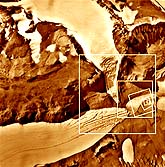
Obviously this is about the ultimate conceivable in unmanned Mars exploration -- if it's possible without a manned drill crew at all -- and it is indeed the end point of the Briggs-McKay plan; they don't see any attempt to do it before 2015 at the absolute earliest and more likely 2020-25 would be more realistic - if it can be done at all. Before such an attempt is made, several earlier Mars landers would have to carry out detailed mapping of the subsurface strata at two or more candidate drilling sites, each using a rover which would lay out a 3-km line of active seismic sensors and explosive charges to map the places at which the subsurface liquid-water layer is closest to the surface and whre the consistency of the rock layers will make drilling easiest. However, a new factor has recently intervened and led Briggs and McKay to modify their plan -- MGS' discovery of possible recent eruptions of liquid groundwater from only a few dozen or a few hundred meters below the surface. It remains to be seen whether this really is liquid water and not, say, subsurface carbon dioxide -- but if it is water (perhaps kept liquid by high salinity), obviously the search for extant Martian microbes surviving in subsurface liquid water will be made tremendously easier. Accordingly, Briggs and McKay have inserted a new type of near-term Mars mission into their plan: a rover capable of landing within a fairly short distance of such a site - even in rugged terrain, driving to it, and then either planting an anchor and rappelling itself down the rather steep slopes on which the eruptions have occurred to reach the surface runoff, or drilling several dozen meters down to reach the possible water layer. In either case, it would then analyze the material it collected, using in-situ life-detection and organic material sensors, to look for signs of either living or dormant microbes. Needless to say, if it found such evidence, the site for the first Mars sample-return mission would be obvious. This mission would certainly require some technological steps we have yet to make -- pinpoint landings, landing hazard avoidance, moderately long-range rovers, and rappelling operations and/or moderately deep sample drilling -- but it's also obviously easier than the much deeper drilling operations that Briggs and McKay had originally thought would be necessary, and they envision such a mission as being possible as early as 2007 or 2009. One mission proposed at the Conference by JPL's C.J. Budney would involve a similar rover -- launched by a Delta as soon as 2007 -- which would drive to the edge of the great Valles Marineris and then rappel as much as 2 km down one of its slopes to examine the geological strata of Mars in this region. Moreover, Mars Express and that possible follow up U.S. Mars orbiter mentioned above could make preliminary examinations of these sites from orbit to see if they are indeed areas where liquid water is close to the surface. Besides subsurface radar sounding, one ingenious but fairly simple "oasis detector" proposed at the Conference by P.H. Smith would use the orbiter's near-IR mineral mapping spectrometer to constantly scan Mars' surface for any signs of recent water vapor release from subsurface vents, and then automatically and immediately photograph and mineral-map that spot in detail without waiting for commands from Earth. Any Mars rovers will have to be carefully sterilized to avoid any risk whatsoever of contaminating the site, and Mars' water table, with Earth germs -- a problem which will become more and more serious as Mars exploration (especially subsurface exploration) progresses. Nevertheless, it could be one of the most logical next steps for us to take after those preliminary orbiters and technology-testing soft landers have flown. MGS' spectacular discovery, however, simply proves once again that Mars still unquestionably has plenty of surprises left to throw at us - and that planning out any exploration program for mars too far in advance is a recipe for trouble. However, as I've said, some advance planning of the overall form of a properly advancing Mars program is necessary -- and Briggs' and McKay's plan received enough positive notice at the Conference that it seems very likely that something pretty similar to it will be adopted by NASA when its official new plan for Mars exploration is released in October or November.
Email This Article Comment On This Article Related Links SpaceDaily Search SpaceDaily Subscribe To SpaceDaily Express Mars News and Information at MarsDaily.com Lunar Dreams and more
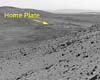
 Spirit Heading To 'Home Plate'
 Pasadena CA (JPL) Jan 09, 2006
Last week Spirit completed robotic-arm work on "El Dorado." The rover used all three of its spectrometers plus the microscopic imager for readings over the New Year's weekend. |
|
|

|
|
|
|
|
|
|
|
|
|
|
|
| The content herein, unless otherwise known to be public domain, are Copyright 1995-2006 - SpaceDaily.AFP and UPI Wire Stories are copyright Agence France-Presse and United Press International. ESA PortalReports are copyright European Space Agency. All NASA sourced material is public domain. Additionalcopyrights may apply in whole or part to other bona fide parties. Advertising does not imply endorsement,agreement or approval of any opinions, statements or information provided by SpaceDaily on any Web page published or hosted by SpaceDaily. Privacy Statement |