|
 |
 |
 |
 |
 |
 |
 |
 |

 |
Decaying Antenna Farm Hints At Glorious Radioastronomy Past
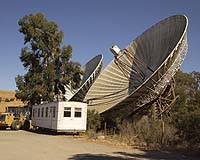
Stanford CA (SPX) Oct 18, 2004 The Dish is Stanford's most famous antenna. But on the other side of Highway 280, down a dirt road and over a wooden bridge, five smaller dishes languish in obscurity, the remnants of radioastronomy experiments terminated in the '70s. Nonetheless, they've managed to attract some attention - that of the university's fire inspector, David Conrod. In June, his visit to the site, which was on a watch list, revealed weed-choked meadows, dilapidated sheds and rusting equipment. He declared the area, known simply as Site 515, a fire hazard and called for its cleanup. "It looks like a Mayan ruin," Professor Channing Robertson, senior associate dean for faculty and academic affairs in the School of Engineering, said. The cost of demolition and cleanup is estimated at $100,000. The university, the School of Engineering and the Electrical Engineering Department will share the expense of reducing vegetation to a level compliant with state fire code - a task expected to be complete by rainy season - and of cleaning up scrap metals on the site and demolishing most buildings there. Robertson called a temporary halt to the demolition last summer once it became apparent that Site 515 was significant for its roles in experiments conducted by electrical engineer Ronald N. Bracewell and other scientists of Stanford's Space, Telecommunications and Radioscience Laboratory (STAR Lab). Demolition of the site's five remaining dish antennas and the building housing the radiotelescope control room has been delayed until June 30, 2005, to give any interested parties a chance to submit proposals for site use. Ultimately, the university will decide the site's fate. Possibilities include reassignment of the land for a new use by the provost or continued use for university research projects. For example, Electrical Engineering Professor Umran Inan, who leads STAR Lab, is interested in using one or more of the dishes to track scientific satellites carrying Stanford-built instruments. Robertson has asked electrical engineering faculty, many of whom toured the site Aug. 17, to propose ways to commemorate the research done there. Bracewell has several photo albums documenting the site's construction and experimental apparatuses. He and others are interested in saving some of the concrete pediments on which the small antenna dishes were mounted. In the '60s and '70s, proving that even scientists are not above graffiti creation, more than 200 astronomers - many famous - chiseled their John Hancocks into the concrete. Stellar past So what was Site 515 used for in the first place? "This location [is] where antennas first reached the angular resolution of the human eye and the microwave sun was mapped for 11 years at daily intervals with an innovative scanning technique with the first radiotelescope ever to print its output (the temperature map) in published form," Bracewell, the Lewis M. Terman Professor, Emeritus, wrote in an e-mail interview. Bracewell came to Stanford in 1955. In 1956, he began to design and build an array of 32 small dish antennas, each 10 feet in diameter, arranged as a cross. The dishes of each arm of the cross were slaved together to move in unison. A similar antenna placed a distance from the cross improved the array's resolution. Beginning in 1961, this "antenna farm" mapped microwaves emitted by the sun. Seven days a week for the 11 years that it took to complete a solar cycle, STAR Lab staff member Joel Deuter would send a microwave spectroheliograph, a temperature map of the sun, to Colorado Springs for the Air Force to distribute around the world. NASA used the solar weather maps, which could predict radiation peaks, to support the first manned landing on the moon. Subsequently, an array of five larger antennas - each 60 feet in diameter - was built. Today their rusty remains are sandwiched between giant mounds of horse manure and a tree farm, on land dominated by jackrabbits, gopher snakes and poison oak. The big dishes were not used in sun-mapping experiments. Instead, they reached out farther into space to study angular diameters, temperatures and polarization of complete galaxies - characteristics that revealed the direction of motion of our solar system relative to the cosmic background. The celestial research conducted at Site 515 also resulted in earthly benefits. The algorithm that Bracewell created to reconstruct astronomical images from scans was universally adopted in computer-assisted tomography (CAT) scanners for medical diagnosis. For that accomplishment, the native Australian was elected a foreign associate of the National Academy of Sciences' Institute of Medicine and received the Heinrich Hertz Medal from the Institute of Electrical and Electronics Engineers. Community Email This Article Comment On This Article Related Links Star Lab SpaceDaily Search SpaceDaily Subscribe To SpaceDaily Express Space Telescope News and Technology at Skynightly.com
 Carl Zeiss And Max Planck Researchers Develop Optical Technology For JWST
 Heidelberg, Germany (SPX) Dec 09, 2005
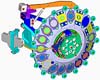
Carl Zeiss Optronics, in Oberkochen, Germany, and the Max Planck Institute for Astronomy in Heidelberg (MPIA), are developing the main fine mechanical optical technology for two instruments to be part of the James Webb Space Telescope (JWST). |
|
|

| The content herein, unless otherwise known to be public domain, are Copyright 1995-2006 - SpaceDaily.AFP and UPI Wire Stories are copyright Agence France-Presse and United Press International. ESA PortalReports are copyright European Space Agency. All NASA sourced material is public domain. Additionalcopyrights may apply in whole or part to other bona fide parties. Advertising does not imply endorsement,agreement or approval of any opinions, statements or information provided by SpaceDaily on any Web page published or hosted by SpaceDaily. Privacy Statement |