|
 |
 |
 |
 |
 |
 |
 |
 |

 |
Death Could Be Averted By 'Downloaded Brains', British Futurologist Says
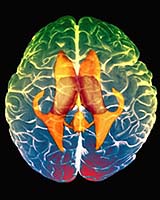
London (AFP) May 22, 2005 Death could become a thing of the past by the mid-21st century as computer technology becomes sophisticated enough for the contents of a brain to be "downloaded" onto a supercomputer, according to a leading British futurologist. However, he told the Observer newspaper on Sunday, this technology might be expensive enough to remain the preserve of the rich for a decade or two more. Among other eyebrow-raising predictions by Ian Pearson, head of the futurology unit at British telecommunications giant BT, is the prospect of computer systems being able to feel emotions. This could eventually involve such things as aeroplanes being programmed to be even more terrified of crashing than their passengers, meaning they would do whatever possible to stay airborne. While the predictions might sound outlandish, they were merely the product of extrapolations drawn from the current rate at which computers are evolving, Pearson said in an interview with the newspaper. "If you draw the timelines, realistically by 2050 we would expect to be able to download your mind into a machine, so when you die it's not a major career problem," he said. "If you're rich enough then by 2050 it's feasible. If you're poor you'll probably have to wait until 2075 or 2080 when it's routine. "We are very serious about it. That's how fast this technology is moving: 45 years is a hell of a long time in IT." As an example of the advances being made, Pearson noted that Sony's new PlayStation 3 computer games console is 35 times as powerful as the model it replaced, and in terms of processing is "one percent as powerful as a human brain". In views which those of a religious persuasion might find hard to handle, Pearson said the next computing goal would be to replicate consciousness. "Consciousness is just another sense, effectively, and that's what we're trying to design on a computer," he said. "Not everyone agrees, but it's my conclusion that it's possible to make a conscious computer with superhuman levels of intelligence before 2020." One of the "primary reasons" for such work would be to give computers emotions, Pearson said. "If I'm on an aeroplane I want the computer to be more terrified of crashing than I am so it does everything to stay in the air until it's supposed to be on the ground." Community Email This Article Comment On This Article Related Links BT SpaceDaily Search SpaceDaily Subscribe To SpaceDaily Express Dirt, rocks and all the stuff we stand on firmly
 Magnetic Reconnection Region Larger Than 2.5 Million Km Found In The Solar Wind
 Paris (ESA) Jan 12, 2006
Using the ESA Cluster spacecraft and the NASA Wind and ACE satellites, a team of American and European scientists have discovered the largest jets of particles created between the Earth and the Sun by magnetic reconnection. This result makes the cover of this week's issue of Nature. |
|
|

| The content herein, unless otherwise known to be public domain, are Copyright 1995-2006 - SpaceDaily.AFP and UPI Wire Stories are copyright Agence France-Presse and United Press International. ESA PortalReports are copyright European Space Agency. All NASA sourced material is public domain. Additionalcopyrights may apply in whole or part to other bona fide parties. Advertising does not imply endorsement,agreement or approval of any opinions, statements or information provided by SpaceDaily on any Web page published or hosted by SpaceDaily. Privacy Statement |