|
 |
 |
 |
 |
 |
 |
 |
 |

 |
Deadly Typhoon Affects 13 Million In Zhejiang
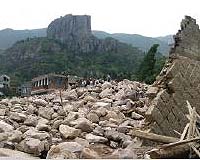
Hangzhou (XNA) Aug 18, 2004 Typhoon Rananim, the worst in 48 years, have already killed at least 164 people and left 24 still missing in east Zhejiang province. Rananim, confirmed by meteorological authorities to be the strongest to hit the Chinese mainland since 1956, had injured more than 1,800 people and affected life of about 13 million in Zhejiang by Monday noon, according to Yu Zhongda, a spokesman with Zhejiang provincial government. The province with a thriving economy on China's east coast has also reported a direct economic lose of 18.1 billion yuan (2.2 billion US dollars). Official statistics indicated that the typhoon affected 75 counties and 765 townships and villages in Zhejiang alone, where 64,300 houses were toppled, 55,000 livestock were killed and infrastructure destroyed. In the aftermath of the typhoon, a disastrous mud-rock flow hit three townships in Yueqing city in eastern Zhejiang on Aug. 13, already killing 29 villagers and leaving 18 others missing by Monday night. The typhoon also destroyed 1,163 kilometers of road, damaged many embankments and water conservancy facilities and cut off power supply and communication. China, however, has remained calm and worked effectively to minimize losses in its fight against the catastrophe. Chinese President Hu Jintao sent instructions on relief work inthe typhoon-hit areas in the wake of the disaster. The provincial and local governments have since been working all out to cure the wounded, resume water and power supply and restore transportation and telecommunication facilities and properly arrange the people's life. As torrential rains might have contaminated the drinking water and the maximum daytime temperature reached 38 degrees Celsius Monday in Zhejiang, the provincial disease prevention and control center has sent medical teams to the typhoon-hit areas to prevent possible epidemic diseases outbreak. Sources with the provincial health authorities say they have sent 50 tons of medicine, disinfector and vaccine to these areas. Local insurance companies are ready to compensate for the losses of the insured. China Meteorological Administration had been watching the typhoon, the 14th and the strongest this year, and worked out forecasts for its landing four days before it hit Zhejiang on Thursday, Aug. 12. The Central Meteorological Station forecast tropical storms on Aug. 9 and 10. On Aug. 11, the station released updated weather services and typhoon alarms every six hours. "The precise forecast of the disastrous typhoon is not accidental," said China's top forecaster Qin Dahe. Qin himself sounded the emergency alarm in the daily weather service at the prime hour on China Central Television on Aug. 12, to warn TV viewers of the forthcoming disaster. The accurate forecast of the typhoon showed China could successfully cope with the paroxysmal disastrous weather, according to Qin, director of China Meteorological Administration. "We have used state-of-the-art technologies in the forecasts to ensure precision," he said in an interview with Xinhua. He said modern radar equipment introduced from foreign countries over the last two years has been deployed in coastal cities including Wenzhou, Ningbo and Zhoushan to monitor typhoon activities, while China's meteorological satellite has precisely tracked the typhoon and sent data timely to ground stations. Thanks to the precise forecast, the Zhejiang provincial government helped evacuate 467,000 people and called back more than 9,900 ships before the catastrophe, effectively minimizing the losses. Source: Xinhua News Agency Community Email This Article Comment On This Article Related Links SpaceDaily Search SpaceDaily Subscribe To SpaceDaily Express The Chinese Space Program - News, Policy and Technology China News from SinoDaily.com
 Taikonauts On Moon A Far Off Dream For China Yet
 Beijing (XNA) Jan 05, 2006
A one-year lunar fly-by mission may start in April 2007 in China, but a manned flight to the Earth's neighbour may be a long way away, a chief lunar exploration scientist said last night. |
|
|

| The content herein, unless otherwise known to be public domain, are Copyright 1995-2006 - SpaceDaily.AFP and UPI Wire Stories are copyright Agence France-Presse and United Press International. ESA PortalReports are copyright European Space Agency. All NASA sourced material is public domain. Additionalcopyrights may apply in whole or part to other bona fide parties. Advertising does not imply endorsement,agreement or approval of any opinions, statements or information provided by SpaceDaily on any Web page published or hosted by SpaceDaily. Privacy Statement |