|
 |
 |
 |
 |
 |
 |
 |
 |

 |
Dark Matter Charted Out To Five Billion Light Years
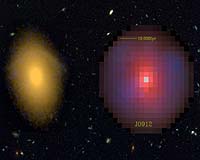
London UK (SPX) Apr 19, 2007 Most of the matter in the Universe is not the ordinary kind made up of protons, neutrons, and electrons, but an elusive "dark matter" detectable only from its gravity. Like a tenuous gas, dark matter is all around us - it goes through us all the time without us noticing - but tends to collect in large quantities around galaxies and clusters of galaxies and makes up about one-sixth of the mass of the Universe. In his talk on Tuesday 17 April at the Royal Astronomical Society National Astronomy Meeting in Preston, Dr Ignacio Ferreras of Kings College London will present the maps of the distribution of "ordinary" and dark matter in nine galaxies out to a distance of five billion light-years from the Sun. Dr Ferreras worked with Dr Prasenjit Saha (University of Zurich, Switzerland) and Professor Scott Burles (Massachusetts Institute of Technology, USA) to take advantage of a rare astronomical phenomenon known as 'gravitational lensing'. The galaxies they studied serendipitously lie in front of quasars, which are bright sources of light at even greater distances. The gravity of the nearer galaxy and dark matter distorts the quasar light, causing the quasar to be seen as two or four images. The placement of these mirage images, studied using new theoretical techniques in gravitational lensing, makes it possible to measure the total mass and effectively gives scientists a telescope for dark matter! By analysing the starlight from the galaxies using stellar evolution theory, it is possible to measure the mass of the stars they contain. Combining these ideas with archival data from the Hubble Space Telescope, Dr Ferreras and his colleagues were able to make dark-matter maps. Current theories of galaxy formation can explain some but not all of these new findings. After the Big Bang, gas should have fallen towards the centres of dark-matter halos, there igniting to form the stars that go on to make up a galaxy. But why is there a higher proportion of dark matter in more massive galaxies? And had these galaxies already finished forming five billion years ago? These questions will only be answered by future theories of galaxy formation. Community Email This Article Comment On This Article Related Links Kings College London Stellar Chemistry, The Universe And All Within It Stellar Chemistry, The Universe And All Within It
 UK Scientists Sift Superfine Stardust
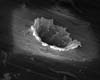 Leicester UK (SPX) Apr 19, 2007
UK scientists are preparing to analyse miniscule impact craters collected by NASA's Stardust mission as it flew through interstellar dust streams. These craters contain the residues of the dust particles that are the seeds of our own Solar System. |
|
|

| The content herein, unless otherwise known to be public domain, are Copyright 1995-2006 - SpaceDaily.AFP and UPI Wire Stories are copyright Agence France-Presse and United Press International. ESA PortalReports are copyright European Space Agency. All NASA sourced material is public domain. Additionalcopyrights may apply in whole or part to other bona fide parties. Advertising does not imply endorsement,agreement or approval of any opinions, statements or information provided by SpaceDaily on any Web page published or hosted by SpaceDaily. Privacy Statement |