|
 |
 |
 |
 |
 |
 |
 |
 |

 |
DNA Study Explains Unique Diversity Among Melanesians
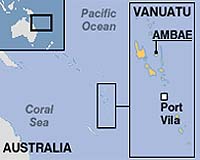
Philadelphia PA (SPX) Mar 01, 2007 Small populations of Melanesians - among the most genetically diverse people on the planet - have significant differences in their mitochondrial DNA that can be linked to where they live, the size of their home island and the language they speak, according to a study being published in the new online journal, Public Library of Science ONE. The study, "Melanesian mtDNA complexity," was lead by Jonathan Friedlaender, emeritus professor of anthropology at Temple University. The study appears in the Feb. 28 issue. Friedlaender and his collaborators from Binghamton University, the Institute for Medical research in New Guinea and the University of Pennsylvania, examined mitochondrial DNA sequences from 32 diverse populations on four Melanesian islands, an island chain north and northeast of Australia that includes Fiji, New Caledonia, Vanuatu, the Solomon Islands, and New Guinea. The islands that were intensively covered were Bougainville, New Ireland, New Britain and New Guinea. "Mitochondrial DNA has been a focus of analysis for about 15 years," says Friedlaender. "It is very interesting in that it is strictly maternally inherited as a block of DNA, so it really allows for the construction of a very deep family tree on the maternal side as new mutations accumulate over the generations on ancestral genetic backgrounds. "In this part of the world, the genealogy extends back more than 35,000 years, when Neanderthals still occupied Europe," he adds. "These island groups were isolated at the edge of the human species range for an incredible length of time, not quite out in the middle of the Pacific, but beyond Australia and New Guinea. During this time they developed this pattern of DNA diversity that is really quite extraordinary, and includes many genetic variants that are unknown elsewhere, that can be tied to specific islands and even specific populations there. Others suggest very ancient links to Australian Aborigines and New Guinea highlanders." Friedlaender also says that the study gives a different perspective on the notion of the "apparent distinctions between humans from different continents, often called racial differences. In this part of the Pacific, there are big differences between groups just from one island to the next - one might have to name five or six new races on this basis, if one were so inclined. Human racial distinctions don't amount to much." The study was funded by grants from the National Science Foundation, the Wenner-Gren Foundation for Anthropological Research, the National Geographic Society Exploration Fund and the Penn Faculty Research Fund. Community Email This Article Comment On This Article Related Links Temple University Public Library of Science ONE All About Human Beings and How We Got To Be Here All About Human Beings and How We Got To Be Here
 Getting On Your Nerves And Repairing Them
 Bethesda MD (SPX) Mar 12, 2007
Here is some news that will certainly get on people's nerves: In a study to be published in the March 2007 issue of The FASEB Journal, scientists from East Carolina University report that a key molecular mechanism, RNA interference (RNAi), plays a role in the regeneration and repair of periphery nerves, which are the nerves located outside of the brain and spinal column. |
|
|

| The content herein, unless otherwise known to be public domain, are Copyright 1995-2006 - SpaceDaily.AFP and UPI Wire Stories are copyright Agence France-Presse and United Press International. ESA PortalReports are copyright European Space Agency. All NASA sourced material is public domain. Additionalcopyrights may apply in whole or part to other bona fide parties. Advertising does not imply endorsement,agreement or approval of any opinions, statements or information provided by SpaceDaily on any Web page published or hosted by SpaceDaily. Privacy Statement |