
 |
 |
 |
 |
 |
 |
 |
 |
 |

 |
DNA Shows That Last Woolly Mammoths Had North American Roots
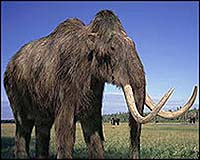
Hamilton, Canada (SPX) Sep 09, 2008 In a surprising reversal of conventional wisdom, a DNA-based study has revealed that the last of the woolly mammoths-which lived between 40,000 and 4,000 years ago-had roots that were exclusively North American. The research, which appears in the September issue of Current Biology, is expected to cause some controversy within the paleontological community. "Scientists have always thought that because mammoths roamed such a huge territory-from Western Europe to Central North America-that North American woolly mammoths were a sideshow of no particular significance to the evolution of the species," said Hendrik Poinar, associate professor in the departments of Anthropology, and Pathology and Molecular Medicine at McMaster University. Poinar and Regis Debruyne, a postdoctoral research fellow in Poinar's lab, spent the last three years collecting and sampling mammoths over much of their former range in Siberia and North America, extracting DNA and meticulously piecing together, comparing and overlapping hundreds of mammoth specimen using the second largest ancient DNA dataset available. "Migrations over Beringia [the land bridge that once spanned the Bering Strait] were rare; it served as a filter to keep eastern and western groups or populations of woollies apart, says Poinar. "However, it now appears that mammoths established themselves in North America much earlier than presumed, then migrated back to Siberia, and eventually replaced all pre-existing haplotypes of mammoths." "Small-scale population replacements, as we call them, are not a rare phenomenon within species, but ones occurring on a continental scale certainly are," says Ross MacPhee, curator of mammalogy at the American Museum of Natural History, and one of the researchers on the study. "We never expected that there might have been a complete overturn in woolly mammoths, but this is the sort of discoveries that are being made using ancient DNA. Bones and teeth are not always sensitive guides." "Like paleontologists, molecular biologists have long been operating under a geographic bias," says Debruyne. "For more than a century, any discussion on the woolly mammoth has primarily focused on the well-studied Eurasian mammoths. Little attention was dedicated to the North American samples, and it was generally assumed their contribution to the evolutionary history of the species was negligible. This study certainly proves otherwise." The origin of mammoths is controversial in itself. Some scientists believe that the first proto-mammoths arose in Africa about seven-million years ago in concert with ancestors of the Asian elephant. Around five to six million years ago, an early mammoth species migrated north into China, Siberia and, eventually, North America. This early dispersal into North America gave rise to a new mammoth known as the Columbian mammoth. Much later, back in Siberia, a cold-adapted form-the woolly mammoth-evolved and eventually crossed over the Beringian land bridge into present-day Alaska and the Yukon. What happened next, says Poinar, is a mystery: The Siberian genetic forms began to disappear and were replaced by North American migrants. "The study of evolution is an evolution in itself," says Poinar. "This latest research shows we're drilling down and getting a closer and better understanding of the origins of life on our planet." Community Email This Article Comment On This Article Share This Article With Planet Earth
Related Links McMaster University Darwin Today At TerraDaily.com
 Biocontrol Insect Exacerbates Invasive Weed
 Madison Wi (SPX) Sep 09, 2008
Biocontrol agents, such as insects, are often released outside of their native ranges to control invasive plants. But scientists in Montana have found that through complex community interactions among deer mice, native plants and seeds, the presence of an introduced fly may exacerbate the effects of the invasive plant it was meant to control. |
|
|

| The content herein, unless otherwise known to be public domain, are Copyright 1995-2007 - SpaceDaily.AFP and UPI Wire Stories are copyright Agence France-Presse and United Press International. ESA Portal Reports are copyright European Space Agency. All NASA sourced material is public domain. Additional copyrights may apply in whole or part to other bona fide parties. Advertising does not imply endorsement,agreement or approval of any opinions, statements or information provided by SpaceDaily on any Web page published or hosted by SpaceDaily. Privacy Statement |
 del.icio.us
 Digg
Digg Reddit
 YahooMyWeb
 Google
 Facebook