|
 |
 |
 |
 |
 |
 |
 |
 |

 |
DLR Boosts Rad Protection For BIRD Sats With Actel
bb
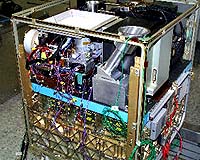
Sunnyvale - July 22, 2002 Actel Corporation announced that its high-reliability, field-programmable gate arrays (FPGAs) have been chosen by the German Aerospace Center (DLR) for its Bi-Spectral Infrared Detection (BIRD) satellite, the world's first satellite that uses infrared sensor technology to detect and investigate high-temperature events on Earth, such as forest fires, volcanic activities, burning oil wells and coal seams. More than 20 Actel high-reliability FPGAs are used in many mission-critical functions on the satellite, including payload data handling, memory management, interfacing and control and co-processing as well as sensor control in the infrared camera. "The BIRD satellite design specifications required devices that offered high performance, radiation tolerance and low power consumption. Actel's FPGAs easily met these needs and enabled us to also satisfy our stringent requirements for single-event upset performance and immunity to destructive heavy ion-induced, single-event latchup effects," said Bernd Kirchner, spokesman of the BIRD mission. "Further, with Actel's devices, we were able to integrate many mission-critical functions into fewer solutions, resulting in a significant reduction in the number of components, total weight and board space required for the satellite design." "Actel continues to be a key player in the technology behind major breakthroughs occurring in space and we plan to continue to push forward with our involvement in and development of high-reliability programmable logic technology for radiation-intensive environments," said Jon Ewald, director of product marketing at Actel. "Actel is proud to play an integral part in the historic BIRD satellite mission, which will supply scientists around the world with data that until now has not been available." Community Email This Article Comment On This Article Related Links Actel Corporation SpaceDaily Search SpaceDaily Subscribe To SpaceDaily Express Space Tourism, Space Transport and Space Exploration News
 Spicing Up Space Meals
 Los Angeles CA (SPX) Jan 04, 2006
Since its launch a year and half ago, Minimus.biz has quickly become the place to go for individual and travel size items. Last week, NASA came to Minimus.biz and purchased several different travel size condiments to send with the astronauts to the International Space Station. |
|
|

| The content herein, unless otherwise known to be public domain, are Copyright 1995-2006 - SpaceDaily.AFP and UPI Wire Stories are copyright Agence France-Presse and United Press International. ESA PortalReports are copyright European Space Agency. All NASA sourced material is public domain. Additionalcopyrights may apply in whole or part to other bona fide parties. Advertising does not imply endorsement,agreement or approval of any opinions, statements or information provided by SpaceDaily on any Web page published or hosted by SpaceDaily. Privacy Statement |