|
 |
 |
 |
 |
 |
 |
 |
 |

 |
DHS IG Slams Senate Oversight Proposal
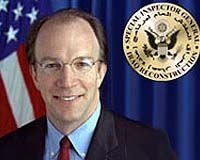
Washington (UPI) Sep 26, 2005 The Homeland Security inspector general is backing a house proposal on oversight of Hurricane Katrina relief spending, over a rival senate bill giving the job to the official in charge of stamping out fraud in the reconstruction of Iraq. Richard Skinner told United Press International that the House bill, proposed by Government Reform Committee Chairman Rep. Tom Davis, R-Va., and the chairman of the financial management subcommittee Rep. Todd Platts, R-Penn., had "a lot of merit." "Essentially that's how we're operating -- pursuant to that bill now as we speak ... (It) will institutionalize, or formalize or legalize what we're already doing," he said. The bill would give a legislative mandate to the homeland security roundtable for inspectors general that Skinner currently chairs -- one of a number of working groups established under the President's Council on Integrity and Efficiency, the body to which all presidentially appointed inspectors general belong. "We have no time for a learning curve," for a new overseer, said Platts introducing his bill, adding that it would "enable this important work, which in many cases is already underway, to be completed in the most effective manner." By contrast, Skinner said Tuesday he had not yet seen the rival senate bill being developed by the chairwoman and ranking democrat of the Senate Committee on Homeland Security and Government Affairs, Susan Collins, R-Maine, and Joseph Lieberman, D-Conn. Collins Spokeswoman Jen Burita said the bill had been dropped Tuesday, and that copies were made available to members that day. The bill was marked up Thursday. The Collins proposal would give the lead oversight role for the $60 billion-plus already appropriated by Congress -- plus additional sepnding down the line -- to Special Inspector General for Iraqi Reconstruction Stuart Bowen. "We simply cannot wait for existing structures to organize and ramp up or create a whole new bureaucracy that will take many months to get up and running," said Collins in a statement. "We need controls that are visible and on the ground as soon as possible." She said Bowen himself had proposed the idea, and that her bill would fund his additional work to the tune of $80 million over the next two years. "If it does pass, we'll work with it," said Skinner, "We'll work with whoever they put in charge." But he said existing inspectors general had a degree of built-in flexibility, which made them able to deploy investigative resources swiftly when necessary. "We're ready willing and able -- and well equipped -- to provide the oversight necessary," he said. "We already have a cadre of people who know how to do this." He told UPI he had this week deployed teams of auditors to the region to begin working with state and local governments, and had 60 people working full-time on Katrina-related issues. Those staff were the team in his office who dealt with FEMA-related matters anyway, he said. "We have other responsibilities," he told UPI. "I don't want to dilute our ability to meet those other responsibilities." As a result, he said, "We're not realigning our overall priorities to deal with this, what we are realigning is our FEMA priorities. "The people working on (Transportation Security Administration) or (Customs and Border Protection) will continue working on those issues." He said using powers under federal emergency legislation like the Stafford Act to hire temporary employees, he aimed to have the team grow to 100 within 90 days and then double again over the next 12 months, as the reconstruction phase got underway. "That's when the big bucks start to get spent," he said. He said the office would remain in business as long as federal reconstruction funds were being spent in the region by FEMA or any other element of the Department of Homeland Security -- perhaps as long as 10 years. He said, despite the $15 million in the second Katrina supplemental appropriation, he would soon be asking for additional funds. "We're still trying to factor that out. We have some good guestimates." "This is the largest thing we've ever dealt with." Skinner said Matthew Jadacki, the former FEMA auditor currently the chief financial officer of the National Weather Service, had been detailed to stand the office up and would begin work next week. Proponents of the Senate measure argue that a special inspector general is necessary because of the multiplicity of different government bodies spending Katrina-related cash. But Skinner said the 12 inspectors general he is coordinating with through his roundtable represent agencies and departments that account for "more than 99 percent" of Katrina spending. The Departments of Defense and Homeland Security between them, he said, are spending about 90 percent of the money at the moment and that proportion will rise as relief and recovery efforts give way to reconstruction and rebuilding. "That's when the other agencies fade away" in terms of their spending, he said. He added that making Bowen divide his time between Iraq and Katrina would not be easy. "From the briefings I've received, I think that bill would create ... additional problems for the inspector general community as a whole," said Skinner. Critics of the Senate proposal say it would create an untenable situation, in which 12 senate-confirmed independent inspectors general would be reporting to a single political appointee. Skinner added that in addition, the involvement of Bowen would create problems of coordination and communication. "With all then activity out there, the last thing we need is a new player on the block," he said. No one disputes the need for careful checks on the huge sums of money being spent -- at the rate of up to $2 billion a day. Inspector general inquiries into the relief spending in the wake of Hurricane Frances a year ago discovered there were repairs made on vehicles not damaged by the hurricane, funeral expenses met for non-disaster related deaths, and rental and repair benefits paid to many whose houses and apartments were not damaged. Skinner said that it was "hard to keep up with everything that's coming down the pike" in terms of new relief measures, but that he had heard congressional estimates of the total spending over the coming decade as topping $300 billion. The conditions under which relief monies had to be spent created many opportunities for malfeasance, he warned. "In the nature of a disaster, especially one this huge, the vulnerabilities are intensified ... Because money is rolling out fast, people are making decisions very, very quickly. We are taking shortcuts, everyone's taking shortcuts in the way we do business to get people up and running again." He said one issue of concern was the hundred-fold increase on the single-item spending limit for government-issued credit card, from $2,500 to $250,000. In 2002, a Defense Department investigation found more than $4 million in unjustifiable credit card purchases by its staff, including payments to casinos and prostitutes, while another probe showed that more than a thousand federal employees had kept active cards after leaving their jobs. Skinner said his office was purchasing special software to enable them to monitor the card's transactions "in real time," and that the department -- in common with other federal entities -- was developing a procedure for their use that would require multiple signoffs for larger purchases. He said another issue of concern was "the way we're contracting," in particular the extensive use of 'No-bid' contracts. "We're going to take a very, very close look at all of those contracts," he pledged, "to see if there was justification and documentation" for them. Community Email This Article Comment On This Article Related Links SpaceDaily Search SpaceDaily Subscribe To SpaceDaily Express Bringing Order To A World Of Disasters A world of storm and tempest When the Earth Quakes
 ISRO Developing Ocean Bottom Warning Sensors
 Bangalore, India (SPX) Jan 11, 2006
Indian Space Research Organisation is developing ocean bottom sensors that will help warn tsunami strikes in advance, the Press Trust Of India reports. |
|
|

| The content herein, unless otherwise known to be public domain, are Copyright 1995-2006 - SpaceDaily.AFP and UPI Wire Stories are copyright Agence France-Presse and United Press International. ESA PortalReports are copyright European Space Agency. All NASA sourced material is public domain. Additionalcopyrights may apply in whole or part to other bona fide parties. Advertising does not imply endorsement,agreement or approval of any opinions, statements or information provided by SpaceDaily on any Web page published or hosted by SpaceDaily. Privacy Statement |