|
 |
 |
 |
 |
 |
 |
 |
 |

 |
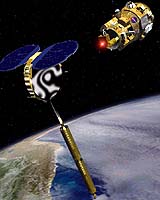
DART Arrives At Vandenberg AFB For Prelaunch Integration And Testing
Dulles VA (SPX) Jul 15, 2004 Orbital Sciences Wednesday announced that its Demonstration of Autonomous Rendezvous (DART) spacecraft has arrived at the company's integration and processing facilities at Vandenberg Air Force Base (VAFB), California for final testing and prelaunch preparations before its launch into orbit. The DART vehicle, which is about six feet long and three feet in diameter and weighs about 800 pounds, will be launched aboard the 36th flight of Orbital's Pegasus space launch vehicle later this year into a polar orbit approximately 475 miles above the Earth. Orbital designed and built the DART spacecraft in Dulles, Virginia for NASA's Marshall Space Flight Center located in Huntsville, Alabama. The DART vehicle is a technology demonstration platform designed to test the technologies required for a spacecraft to locate and rendezvous with another spacecraft without direct human guidance. While NASA has performed rendezvous and docking missions in the past, such as the Space Shuttle locating and docking with the International Space Station (ISS), astronauts have always piloted the spacecraft. The DART mission will be performed autonomously by onboard computer systems without direct human involvement in the control of the vehicle. The technologies demonstrated by DART represent a critical step forward in establishing an autonomous rendezvous capability for the United States, laying the groundwork for future reusable manned and unmanned launch vehicle operations. Future applications of this technology include cargo delivery, in-orbit space assembly and other on-orbit activities such as satellite retrieval and servicing missions. Following its launch aboard the Pegasus rocket, DART will perform a series of in-orbit maneuvers to arrive at a point near a target satellite using state-of-the-art Global Positioning System (GPS) navigation techniques. Using the vehicle's main instrument, the Advanced Video Guidance Sensor (AVGS), DART will then approach the target satellite and perform a series of proximity operations including station keeping, docking axis approaches and circumnavigation. Finally, the vehicle will demonstrate a collision avoidance maneuver and then depart the vicinity and transition to its final orbit. The entire mission sequence will be accomplished under autonomous control and will be completed in under 24 hours. Community Email This Article Comment On This Article Related Links Orbital Marshall Space Flight Center SpaceDaily Search SpaceDaily Subscribe To SpaceDaily Express All about the robots on Earth and beyond!
 Engineers Deliver Robot to Neutralize Remote Explosives
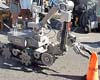 Tyndall AFB (SPX) Jun 30, 2005
Engineers from the Air Force Research Laboratory Materials and Manufacturing Directorate have rapidly prototyped, developed, and delivered low-cost expendable robots to disable and dispose of improvised explosive devices. |
|
|

| The content herein, unless otherwise known to be public domain, are Copyright 1995-2006 - SpaceDaily.AFP and UPI Wire Stories are copyright Agence France-Presse and United Press International. ESA PortalReports are copyright European Space Agency. All NASA sourced material is public domain. Additionalcopyrights may apply in whole or part to other bona fide parties. Advertising does not imply endorsement,agreement or approval of any opinions, statements or information provided by SpaceDaily on any Web page published or hosted by SpaceDaily. Privacy Statement |