
 |
 |
 |
 |
 |
 |
 |
 |
 |

 |
DARPA Technology Enables Continued Flight In Spite Of Catastrophic Wing Damage
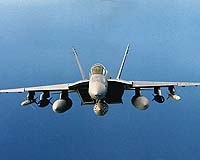
Arlington, VA (SPX) Jun 19, 2008 The Defense Advanced Research Projects Agency (DARPA) has demonstrated that damage tolerant flight control technology can successfully allow an unmanned aerial vehicle to continue to fly even after losing large portions of its wing. In April, DARPA's Damage Tolerant Controls program completed a series of demonstrations culminating in recovery from loss of the majority of the right wing of a sub-scale F/A-18. The aircraft, under fully autonomous control from takeoff to landing, recovered from the catastrophic wing damage within seconds, and over the next few minutes the flight control system reconfigured itself to restore most of the original flight quality, allowing the aircraft to complete a flawless autonomous touchdown. The goal of DARPA's Damage Tolerant Controls program is to establish the ability of adaptive control methods to enable unmanned aircraft to continue to operate in the event of battle damage. DARPA Program Manager Lt. Col. Jim McCormick explained, "We wanted to give autonomous aircraft an 'air sense' that would allow them to deal with the unexpected, the way a human pilot might. But more than that, a fully developed system promises significant advantages in terms of responsiveness to a wide range of operationally relevant conditions with greater speed, fidelity, and robustness. And that means better survivability, safety, and effectiveness for our warfighters." According to McCormick, pilots have made some very spectacular recoveries, such as the Israeli pilot who safely landed an F-15 after losing an entire wing in a mid-air collision, but he added, "This kind of a recovery has never before been accomplished by an autonomous system." Col. Don Hazelwood, Project Manager for Army Unmanned Aircraft Systems, explained the significance of the accomplishment, "Our warfighters increasingly rely on unmanned aircraft for vital combat capabilities, and the impact of any disruption is much greater than the mere cost of the aircraft. "This is a very elegant capability that will enhance the availability of unmanned air system-based combat services in the face of battle damage, component failures, or system degradation. "The extraordinary flexibility of the damage tolerance approach will reduce the burden of training on our operators, limit the impact of pilot error, and lessen our dependence on pre-positioned ground equipment." The contractor for DARPA's Damage Tolerant Controls program is Rockwell Collins Control Technology. In the next phase of the program, DARPA hopes to rapidly integrate damage tolerance into an operational DoD unmanned air system to show the maturity of the capability and the ease with which it can be fielded. Community Email This Article Comment On This Article Share This Article With Planet Earth
Related Links Aerospace News at SpaceMart.com
 The Tu-144: The Future That Never Was
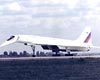 Moscow (RIA Novosti) Jun 13, 2008
Thirty-five years ago, on June 3, 1973, a Tu-144 supersonic airliner crashed during a demonstration flight at Le Bourget in France. The first and last Soviet supersonic passenger plane, which was the fastest commercial aircraft in history, opened the way for liners of a new class. Unfortunately, the road proved too short. |
|
|

| The content herein, unless otherwise known to be public domain, are Copyright 1995-2007 - SpaceDaily.AFP and UPI Wire Stories are copyright Agence France-Presse and United Press International. ESA Portal Reports are copyright European Space Agency. All NASA sourced material is public domain. Additional copyrights may apply in whole or part to other bona fide parties. Advertising does not imply endorsement,agreement or approval of any opinions, statements or information provided by SpaceDaily on any Web page published or hosted by SpaceDaily. Privacy Statement |
 del.icio.us
 Digg
Digg Reddit
 YahooMyWeb
 Google
 Facebook