|
 |
 |
 |
 |
 |
 |
 |
 |

 |
DARPA And Air Force Select Falcon Phase I Contractors
Washington - Nov 18, 2003 The Defense Advanced Research Projects Agency (DARPA) and the U.S. Air Force have selected teams for the first phase of the Force Application and Launch from the Continental U.S. (FALCON) program. Nine contractors were selected for negotiations for Task 1 (Small Launch Vehicle) and three contractors were selected for negotiations for Task 2 (Hypersonic Weapon Systems). Subject to successful negotiations, each contractor will conduct a six-month system definition study within its respective task. At the conclusion of Phase I, DARPA and the Air Force will decide whether to proceed with Phase II, which would be a 36-month design and development effort. FALCON Phase I, Task 1 contractors will receive between $350,000 and $540,000 each for their Phase I effort. Task 1 contractors are listed below.
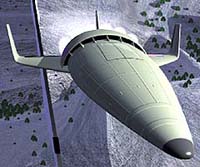
The fundamental underpinning of the technical approach to be taken in the FALCON program is the recognition that a common set of technologies can be matured in an evolutionary manner that will provide a near-term (circa 2010) operational capability for responsive, affordable smallsat spacelift and prompt global strike from the continental U.S. (or equivalent reach from alternative U.S. basing) while also enabling future development of a reusable Hypersonic Cruise Vehicle for the far-term (circa 2025). In FALCON Phase I Task 1, contractors will develop conceptual designs, performance predictions, cost objectives, and development and demonstration plans for the Small Launch Vehicle (SLV). The SLV will provide a low-cost, responsive launch capability capable of placing a small satellite or other payload weighing approximately 1,000 pounds into a low Earth orbit at a total launch cost of less than $5,000,000 (excluding payload and payload integration costs). In FALCON Phase I Task 2, contractors will develop conceptual designs, concepts of operations, and a demonstration plan and identify critical technologies for the Hypersonic Weapon Systems portion of the program, which includes the Common Aero Vehicle, the Enhanced Common Aero Vehicle, and the Hypersonic Cruise Vehicle. The Common Aero Vehicle will be an unpowered, maneuverable, hypersonic glide vehicle capable of carrying approximately 1,000 pounds of munitions, with a range of approximately 3,000 nautical miles. The Enhanced Common Aero Vehicle would be a more advanced design that offered substantially greater range and improved maneuverability. The reusable Hypersonic Cruise Vehicle will be an autonomous aircraft capable of taking off from a conventional military runway and striking targets 9,000 nautical miles distant in less than two hours. DARPA is responsible for overall program management of the FALCON program. DARPA manages the program, with the Air Force Space Command Space and Missile Systems Center providing a deputy program manager. Representatives from Air Force Space Command Space and Missile Systems Center/Detachment 12, Air Force Space Command DR and the Air Force Research Laboratory provide technical assistance and support in conducting milestone reviews. Community Email This Article Comment On This Article Related Links DARPA SpaceDaily Search SpaceDaily Subscribe To SpaceDaily Express Rocket Science News at Space-Travel.Com
 Successful First Test For Vega's Zefiro 9 Engine
 Paris, France(ESA) Dec 28, 2005
Flames, smoke and a deafening noise accompanied the first firing test of Vega's Zefiro 9 third-stage solid rocket motor. A first examination of the data indicates that everything went well at the test carried out yesterday at Salto de Quirra in southeast Sardinia. |
|
|

| The content herein, unless otherwise known to be public domain, are Copyright 1995-2006 - SpaceDaily.AFP and UPI Wire Stories are copyright Agence France-Presse and United Press International. ESA PortalReports are copyright European Space Agency. All NASA sourced material is public domain. Additionalcopyrights may apply in whole or part to other bona fide parties. Advertising does not imply endorsement,agreement or approval of any opinions, statements or information provided by SpaceDaily on any Web page published or hosted by SpaceDaily. Privacy Statement |