|
 |
 |
 |
 |
 |
 |
 |
 |

 |
DARE for Planetary Exploration
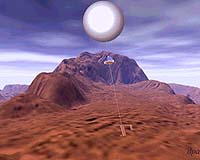
Altadena - Nov 12, 2002 Balloons outfitted with innovative steering devices and robot probes could be the future of planetary exploration. Dr. Alexey Pankine, a fellow at the NASA Institute for Advanced Concepts (NIAC), presented an analysis of balloon applications for planetary science at the World Space Congress in Houston, Texas last month. His study, entitled Directed Aerial Robot Explorers or DARE, is funded by NIAC. At the center of the DARE concept are balloons that can float in planetary atmospheres for many days. Balloons have long been recognized as low-cost observational platforms and are routinely used in observations of the Earth's atmosphere. In 1984, two balloons were successfully deployed in the atmosphere of Venus for a short mission. However, what has restrained the wider use of balloons in planetary exploration was the inability to control their paths in strong atmospheric winds. Attaching an engine to a balloon would convert it into an airship and make it too heavy, too power dependent and too expensive to send to another planet or high into the atmosphere. Faced with this problem, Global Aerospace Corporation has proposed to use an innovative device called the StratoSail� that allows the user to control the path of a planetary balloon. The device is essentially a wing that hangs on a long tether (several kilometers) below the balloon. Strong winds and denser atmosphere at the wing altitude create a sideways lifting force that pulls the entire system across the winds. The DARE concept analyzes the use of the StratoSail� device on several planets in our Solar System that have atmosphere -- Venus, Mars, Jupiter and Titan (a satellite of Saturn). Dr. Pankine reports that a small, light wing will pull the balloon with a velocity of about 1 m/s across the winds on those planets. This may not seem much, but applied constantly (without consuming any power!) for the duration of a long mission (100 days) it would allow for pole-to-pole exploration of the atmospheres of Venus and Titan, and targeted observations of Mars and the vast Great Red Spot of Jupiter. DARE platforms would carry high-resolution cameras and other instruments to study surfaces and atmospheres of the planets. Dr. Pankine envisions small probes being deployed from DARE platforms over a site of interest. These robot-probes would, for example, analyze atmosphere during their descent on Venus and Jupiter or crawl around after soft landing on the surfaces of Mars and Titan. "The ability to alter the flight path in the atmosphere and to deploy the probes would vastly expand the capabilities of planetary balloons and make possible breakthrough observations that are not feasible with any other platform," says Dr. Pankine. The figure illustrates a DARE platform operating at Venus. Community Email This Article Comment On This Article Related Links Global Aerospace Corporation SpaceDaily Search SpaceDaily Subscribe To SpaceDaily Express Planetary Science News at SpaceDaily.com
 The Forgotten Methane Source
 Heidelberg, Germany (SPX) Jan 11, 2006
In the last few years, more and more research has focused on the biosphere; particularly, on how gases which influence the climate are exchanged between the biosphere and atmosphere. Researchers from the Max Planck Institute for Nuclear Physics have now carefully analysed which organic gases are emitted from plants. |
|
|

| The content herein, unless otherwise known to be public domain, are Copyright 1995-2006 - SpaceDaily.AFP and UPI Wire Stories are copyright Agence France-Presse and United Press International. ESA PortalReports are copyright European Space Agency. All NASA sourced material is public domain. Additionalcopyrights may apply in whole or part to other bona fide parties. Advertising does not imply endorsement,agreement or approval of any opinions, statements or information provided by SpaceDaily on any Web page published or hosted by SpaceDaily. Privacy Statement |