|
 |
 |
 |
 |
 |
 |
 |
 |

 |
Cut from Different Cloth
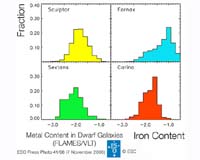
Groningen, Holland (SPX) Nov 09, 2006 A large survey, made with ESO's VLT, has shed light on our Galaxy's ancestry. After determining the chemical composition of over 2000 stars in four of the nearest dwarf galaxies to our own, astronomers have demonstrated fundamental differences in their make-up, casting doubt on the theory that these diminutive galaxies could ever have formed the building blocks of our Milky Way Galaxy. "The chemistry we see in the stars in these dwarf galaxies is just not consistent with current cosmological models," said Amina Helmi of the Kapteyn Astronomical Institute in Groningen, The Netherlands, and lead author of the paper presenting the results. "It shows that there is plenty of astronomy to learn in our backyard." Our Milky Way Galaxy is surrounded by a number of dwarf satellite galaxies, which because of their loosely rounded shape are referred to as 'dwarf spheroidal' galaxies. Faint and diffuse, these dwarf galaxies are a thousand times fainter than the Milky Way itself, making them the least luminous galaxies known. Modern cosmological models predict that small galaxies form first, and later assemble into larger systems like our Galaxy. Since the Universe initially only contained hydrogen and helium (most of all other chemical elements being synthesized inside stars), dwarf galaxies should have the lowest heavy element [1] content. Not so, say the astronomers. As part of a large observational programme, the Dwarf galaxies Abundances and Radial-velocities Team (DART), Helmi and her colleagues from institutes in 9 different countries used the FLAMES [2] instrument on ESO's Very Large Telescope to measure the amount of iron in over 2000 individual giant stars in the Fornax, Sculptor, Sextans and Carina dwarf spheroidals [3]. Their data unearthed fundamental differences in the dwarf galaxy stars' chemical composition compared with those in our galactic halo, calling into question the merger theory as the origin of large galaxies' haloes. Whilst the average abundances of elements in the dwarf spheroidals is comparable with that seen in the Galactic halo, the former are lacking the very metal-poor stars that are seen in the Milky Way - the two types of systems, contrary to theoretical predictions, are essentially of different descent. "Our results rule out any merging of the nearby dwarf galaxies as a mechanism for building up the Galactic halo, even in the early history of the Universe," said Helmi. "More detailed chemical abundance studies of these systems are needed, as this will tell us more about what happened at those early epochs in our local Universe". Details of this study are published in a Letter in the Astrophysical Journal of 10 November 2006 by Amina Helmi et al, entitled "A new view of the dwarf spheroidal satellites of the Milky Way from VLT/FLAMES: Where are the metal-poor stars?" (ApJ Lett, vol. 651, L121-L124). The DART team consists of Eline Tolstoy, Amina Helmi, Giuseppina Battaglia, and Bruno Letarte (University of Groningen, The Netherlands), Mike Irwin (University of Cambridge, UK), Vanessa Hill (Observatory of Paris-Meudon, France), Patrick Fran�ois (Observatory of Paris-Meudon, France and ESO, Chile), Pascale Jablonka (Ecole Polytechnique Federale de Lausanne, Switzerland), Kim Venn (University of Victoria, Canada), Matthew Shetrone (University of Texas, USA), Nobuo Arimoto (National Astronomical Observatory of Japan), Tom Abel (Kavli Institute for Particle Astrophysics and Cosmology, USA), Andreas Kaufer and Thomas Szeifert (ESO, Chile), Francesca Primas (ESO, Germany), and K. Sadakane (Osaka Kyoiku University, Japan). Community Email This Article Comment On This Article Related Links Science and more at Groningen Stellar Chemistry, The Universe And All Within It GPS Applications, Technology and Suppliers
 Northrop Grumman Showcases Comprehensive Suite of Geospatial Intelligence Solutions
 Orlando (SPX) Nov 09, 2006
Northrop Grumman Corporation will highlight solutions to support the national security and intelligence communities next week at the U.S. Geospatial Intelligence Foundation's GEOINT 2006 Symposium. The exposition will be held Nov. 13-16 at the Gaylord Palms Resort and Convention Center in Orlando, Fla. |
|
|

| The content herein, unless otherwise known to be public domain, are Copyright 1995-2006 - SpaceDaily.AFP and UPI Wire Stories are copyright Agence France-Presse and United Press International. ESA PortalReports are copyright European Space Agency. All NASA sourced material is public domain. Additionalcopyrights may apply in whole or part to other bona fide parties. Advertising does not imply endorsement,agreement or approval of any opinions, statements or information provided by SpaceDaily on any Web page published or hosted by SpaceDaily. Privacy Statement |