|
 |
 |
 |
 |
 |
 |
 |
 |

 |
Current Status of Hayabusa and Events Scheduled in November
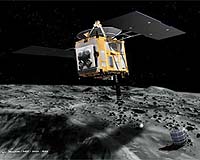
Tokyo, Japan (SPX) Nov 01, 2005 Hayabusa that arrived at the target asteroid Itokawa on September 12th of this year has performed detailed scientific observation so far by varying its relative position around Itokawa. As already reported, Hayabusa carried two reaction wheels were lost on July 31st and October 3rd, and its attitude has been maintained by a single wheel together with the chemical engines aboard, while the spacecraft has been operated normally. In order that the flight can be carried out and completed until the return to the Earth, the fuel consumption required for stabilizing the attitude has to be reduced, and a strenuous effort has been poured to devise the strategy including a number of firing tests in vacuum on the ground. A new control scheme making the firing impulse enough small has now been developed assuring the attitude control resolution to be well managed. This assures the fuel amount required is adequate within that remains. The on-orbit function test was already conducted and it was verified functioning by the actual flight hardware and software aboard. The Hayabusa project team concluded the flight operation until the return to the Earth is feasibly performed, as long as the existing instruments and hardware aboard continue working normally as they are. The proximity operation assumed in November next month consists of one Rehearsal Descent plus two Touching-downs for sampling. They are scheduled as follows:
These events will occur around noon in Japan Standard Time in the midst of the operation period from Japan. There are several Rehearsal and Touching-down sites candidates and the events instances may be shifted earlier or later by 6 hours at maximum, depending on the operation status. The concrete schedule will be released as soon as they are determined.
Hayabusa Succeeds In Observing The 'Oposition Surge' Of Itokawa Tokyo, Japan (SPX) Oct 28, 2005 How much brighter is the full Moon than the quarter Moon? If we consider the ratio of the illuminated area, "Double" seems to be a reasonable answer. But in reality, the full Moon is more than four times bighter than the quarter Moon. Why? The "phase angle" is defined as the angle between the lines connecting tne Sun-Target and the Target-Observer. Namely, the phase angle for the quarter Moon is 90 degree, and that for the full Moon is almost 0 degree. It is well known that airless bodies in our Solar System, such as the Moon, generally show a brightness enhancement when the phase angle approaches zero. This phenenomenon is called the "opposition surge". Do we observe the "opposition surge" on Itokawa? You can find the answer in the images below. The phase angle was abour 35 degrees for the left image and less than 1 degree for the right image. The Hayabusa camera team confirmed the "oposition surge" through careful inspection of these images. More detailed analysis provides important information on the surface state, such as the difference between bare rocks and sands. The observation of the "opposition surge" was not a serendipity, but one result of an elaborate operation. Hayabusa had to come to the Sun-Itokawa line at the distance of 3 hundred million kilometers from the Earth. The position tolerance was approximately the size of Itokawa, namely a few hundred meters. The Hayabusa navigation team accomplished the feat by skillful guiding. Community Email This Article Comment On This Article Related Links Japan Aerospace Exploration Agency (JAXA) SpaceDaily Search SpaceDaily Subscribe To SpaceDaily Express Asteroid and Comet Mission News, Science and Technology
 NASA'S Spitzer Finds Possible Comet Dust Around Dead Star
 Pasadena CA (SPX) Jan 12, 2006
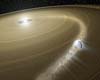
NASA's Spitzer Space Telescope has spotted what may be comet dust sprinkled around the white dwarf star G29-38, which died approximately 500 million years ago. |
|
|

| The content herein, unless otherwise known to be public domain, are Copyright 1995-2006 - SpaceDaily.AFP and UPI Wire Stories are copyright Agence France-Presse and United Press International. ESA PortalReports are copyright European Space Agency. All NASA sourced material is public domain. Additionalcopyrights may apply in whole or part to other bona fide parties. Advertising does not imply endorsement,agreement or approval of any opinions, statements or information provided by SpaceDaily on any Web page published or hosted by SpaceDaily. Privacy Statement |